


Direct Answer
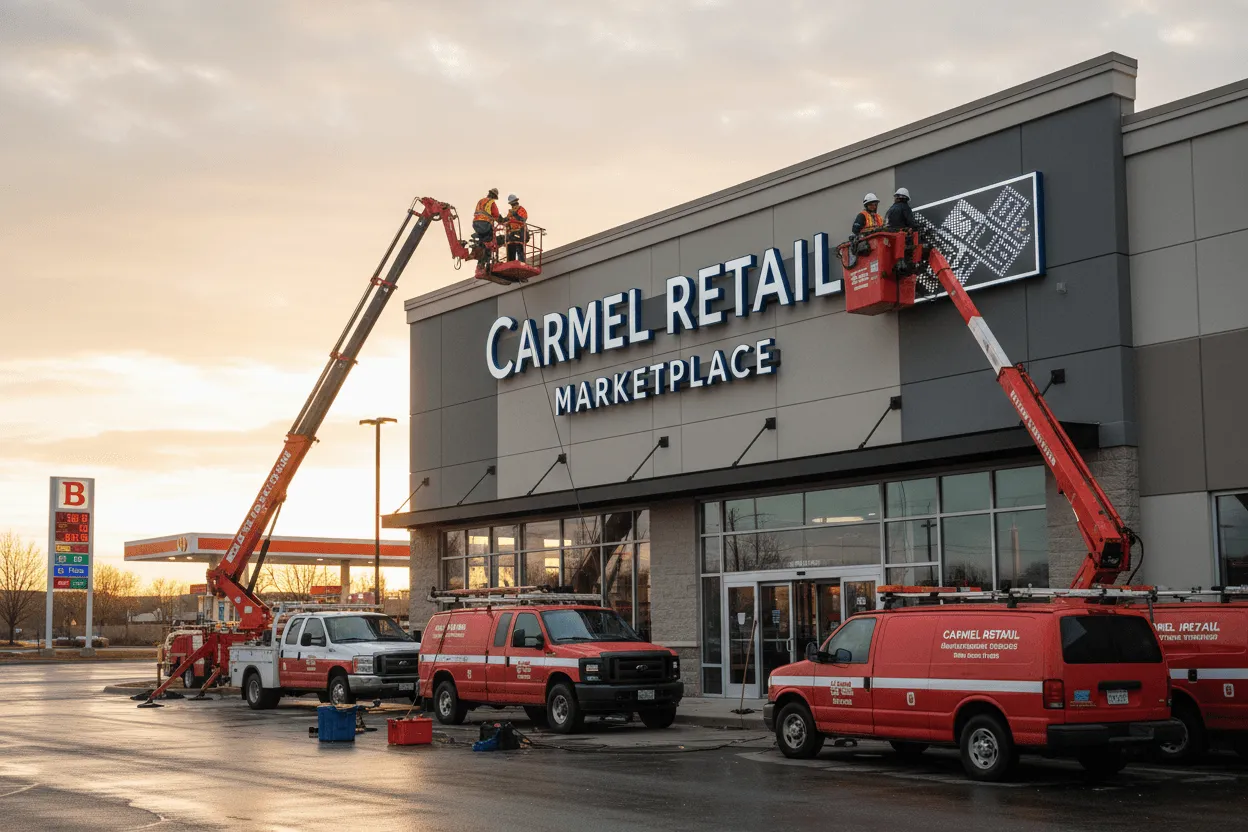
Lighting signage installation in Carmel IN encompasses LED channel letters, monument sign illumination, parking lot lighting, and electronic message center integration for commercial properties throughout Hamilton County. Midwest Signs provides full-service sign installation services for national sign companies and facilities management firms across the Indianapolis metro. With 40+ years of experience and responsive 24-48 hour dispatch, we handle everything from permit coordination to after-hours emergency repairs throughout Indiana, Illinois, Ohio, and Kentucky.
Why Carmel Sign and Lighting Projects Require Different Expertise
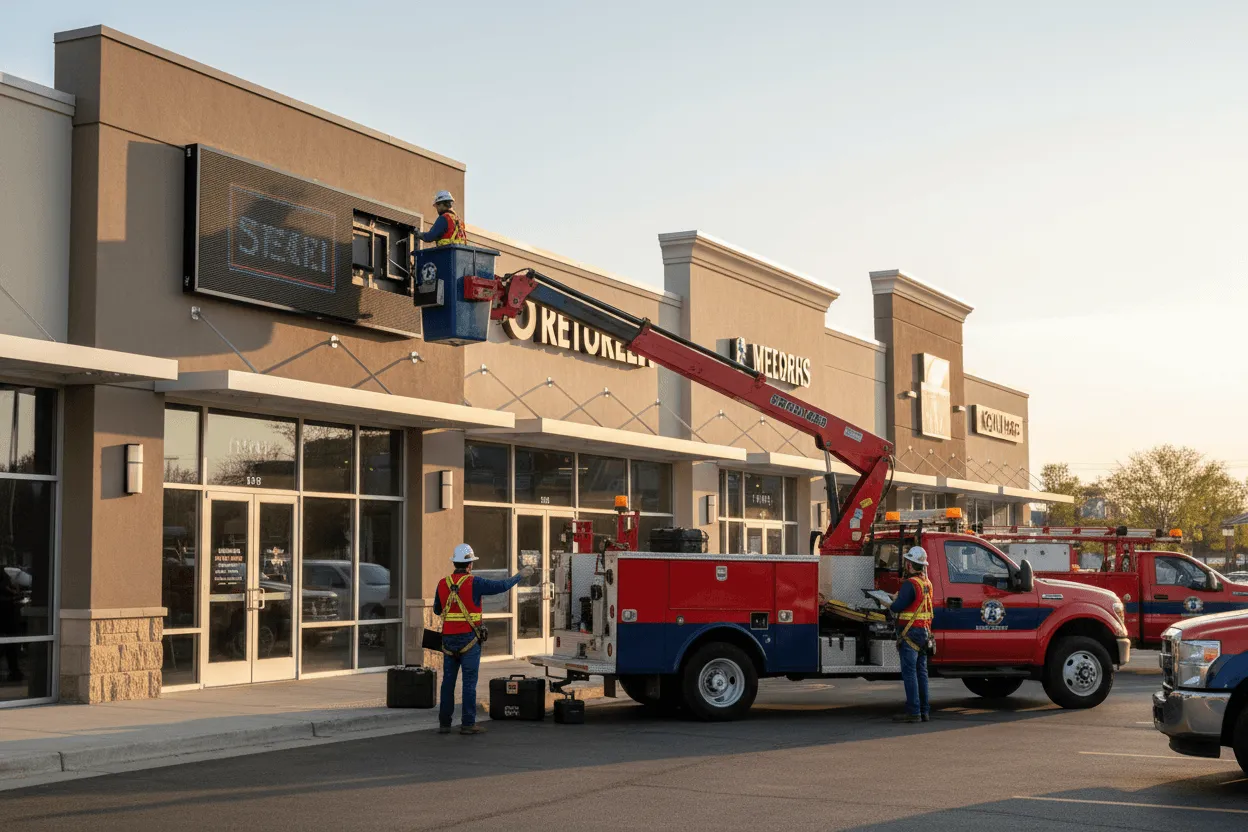
Photometric requirements are quantifiable light measurement standards that regulate how much illumination a sign can project beyond property boundaries. Professional lighting signage installation in Carmel IN requires coordination between electrical infrastructure, municipal sign codes, and photometric requirements that differ significantly from Marion County standards.
Carmel operates under Hamilton County jurisdiction, which means your permit process runs through a different approval system than Indianapolis projects. The city’s Department of Community Services demands detailed photometric studies before approving any illuminated signage. And Carmel’s Arts District and City Center zones require photometric studies for any illuminated signage exceeding 0.5 foot-candles at property lines—substantially stricter than surrounding municipalities.
Hamilton County Electrical Permit Differences
Hamilton County permits require separate electrical inspections beyond standard sign permits. Your service partner needs Indiana electrical licenses and familiarity with the county’s online permit portal, which differs from the systems in Marion or Boone counties. Based on our experience across multi-county installations, Hamilton County inspectors scrutinize transformer placement and conduit routing more carefully than their Marion County counterparts.
Carmel Design District Photometric Standards
Carmel sign regulations in the Old Town and Arts District zones go beyond Indiana building code minimums. You’ll need engineered photometric studies showing foot-candle measurements at multiple property line points. Channel letter installations that would pass approval in Noblesville often require fixture adjustments or dimming controls to meet Carmel’s stricter standards.
National partners working with retail clients in Carmel City Center frequently underestimate the coordination required with Carmel DOCS. Permit timelines run 3-4 weeks longer than standard Indiana projects, and approvals often require revisions to lighting intensity or fixture specifications that weren’t flagged in other markets.
What National Sign Companies Need from Regional Installation Partners
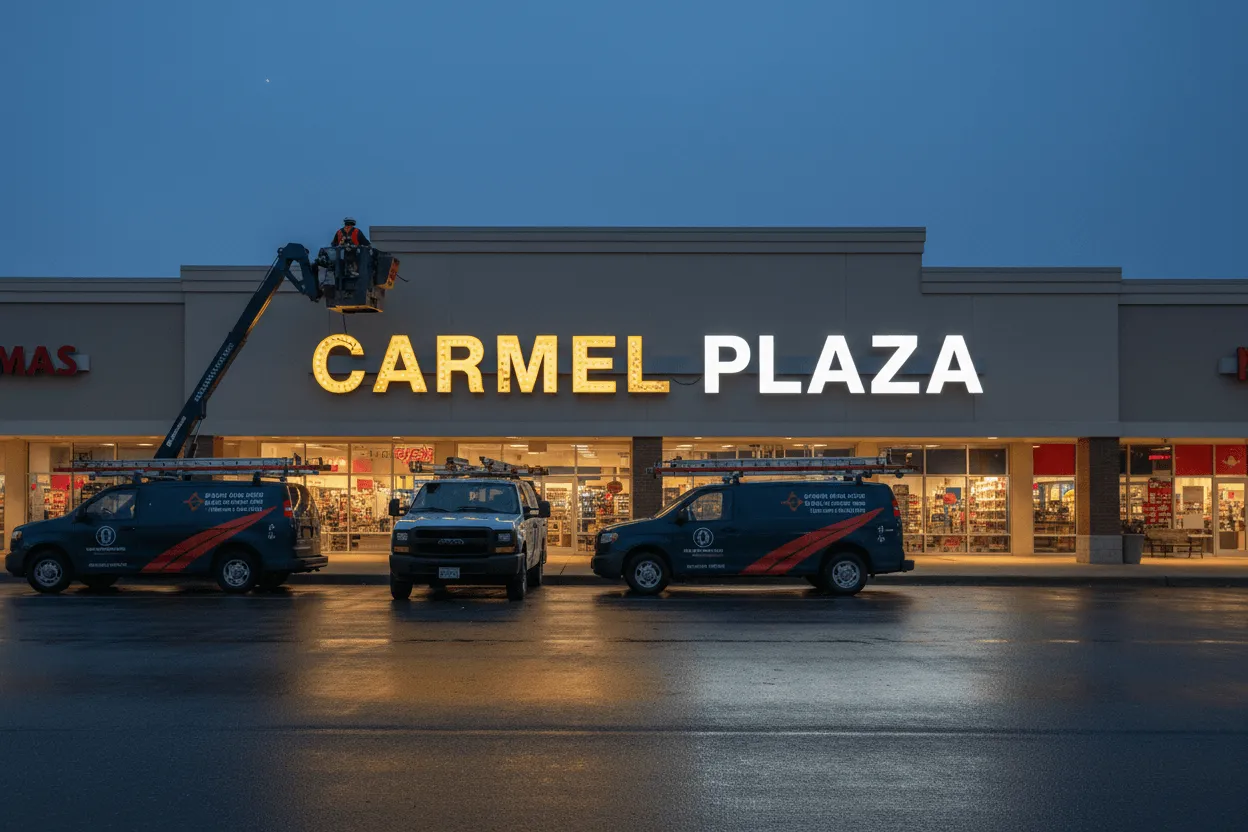
National sign companies partnering in the Indianapolis metro area require installation teams with multi-state electrical licensing and proven documentation systems for warranty compliance. Your project managers can’t babysit every install across four states. You need a sign service partner who handles the entire project lifecycle without constant check-ins.
National accounts coordination demands specific capabilities most regional installers don’t have. We’re talking pre-installation site photos with GPS metadata, electronic warranty documentation uploads within 48 hours, and real-time project status updates through your preferred system. Your clients expect this level of detail whether it’s a single monument sign in Carmel or a 15-location rollout across the Midwest.
Documentation and Warranty Compliance
Your reputation lives or dies on documentation accuracy. Here’s what matters for warranty validation:
- Complete photometric readings for all LED lighting systems before sign-off
- Digital as-builts showing exact mounting locations and electrical routing
- Manufacturer certification uploads with serial numbers and installation dates
- Local permit closure documentation from Hamilton County and surrounding jurisdictions
Most regional sign installation teams still use paper-based systems that create gaps in your warranty chain. We’ve used electronic documentation systems since 2019 because missing a serial number photograph costs you thousands when a client files a warranty claim two years later.
Multi-State Coverage Requirements
National sign rollout projects typically require 24-48 hour response times from regional service partners to maintain brand consistency schedules. Our project survey services and regional rollout coordination cover Indiana, Illinois, Ohio, and Kentucky with the electrical licensing and permit relationships your timeline demands.
LED Lighting Retrofits: Energy Savings vs. Maintenance Reduction in 2026
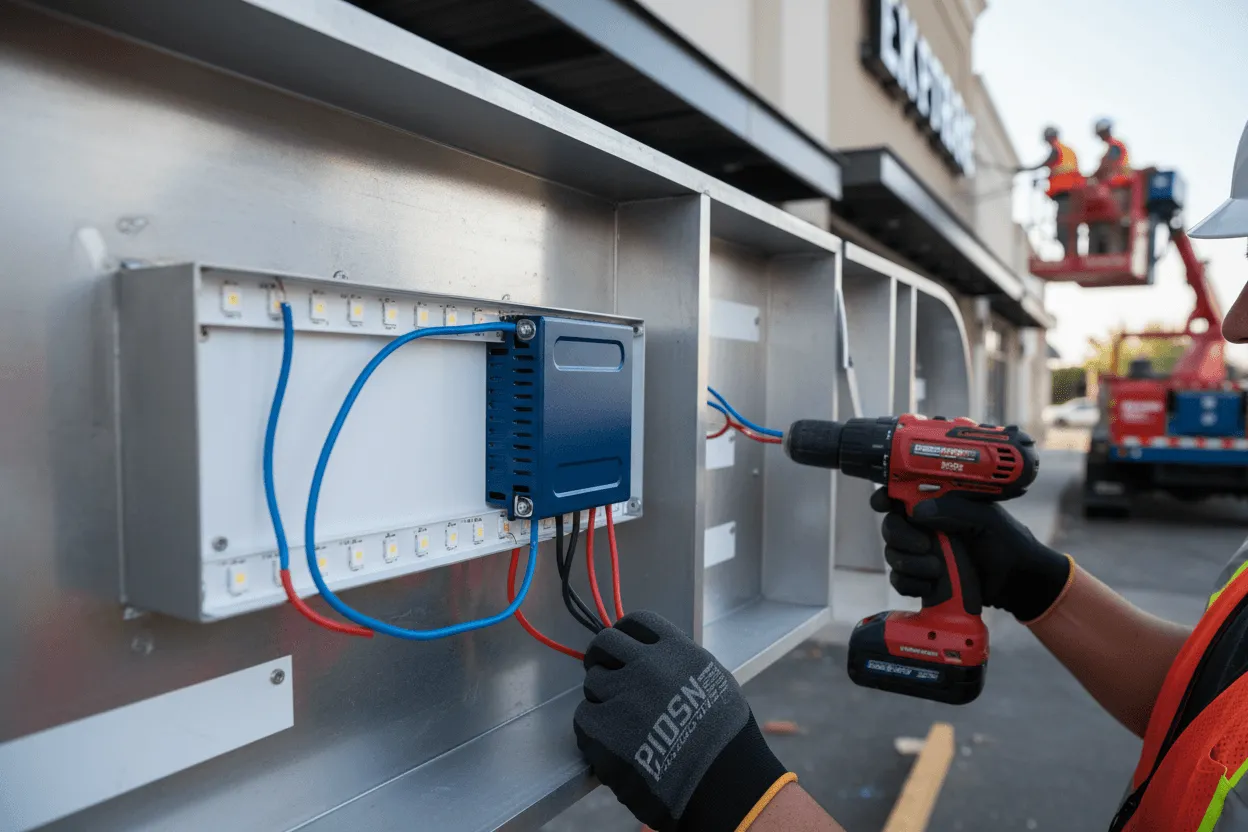
An LED retrofit is the process of replacing outdated fluorescent or neon sign lighting with modern LED modules that reduce energy consumption while extending service intervals. For facilities managers overseeing multi-location portfolios, the maintenance savings often outweigh the utility bill reduction.
LED sign lighting systems installed in 2026 consume 60-75% less energy than fluorescent and neon equivalents from the 2000s. Maintenance calls drop by approximately 80% following LED retrofits due to 50,000+ hour rated lifespans versus 10,000-15,000 hours for traditional sources. Here’s the thing: procurement managers often justify LED retrofit signage projects based on energy savings alone, but the real ROI comes from eliminating emergency service calls at retail locations across Carmel and neighboring Hamilton County markets.
Real-World Energy Consumption Data
The difference becomes obvious when you compare monthly operating costs across lighting technologies:
| Lighting Type | Watts per 4′ Section | Monthly Cost (12hr/day) | Expected Lifespan |
|---|---|---|---|
| Fluorescent (T12) | 120W | $15.40 | 12,000 hours |
| Neon | 90W | $11.55 | 10,000 hours |
| LED (2026) | 28W | $3.60 | 65,000 hours |
The Hidden Cost: Service Call Frequency
LED technology in 2026 has matured to the point where retrofit projects pay for themselves through reduced maintenance calls alone, independent of energy savings. Based on our experience serving national sign companies, a 20-location restaurant chain running fluorescent cabinet signs averages 18-24 service calls annually. After LED conversion, that drops to 3-4 calls.
LED retrofit projects in 2026 typically reduce sign lighting energy consumption by 60-75% while improving visibility and reducing maintenance calls by nearly 80%. And newer LED digital signs include remote diagnostics that eliminate site visits entirely for many troubleshooting situations.
Channel Letters, Cabinet Signs, and Monument Lighting: Installation Considerations
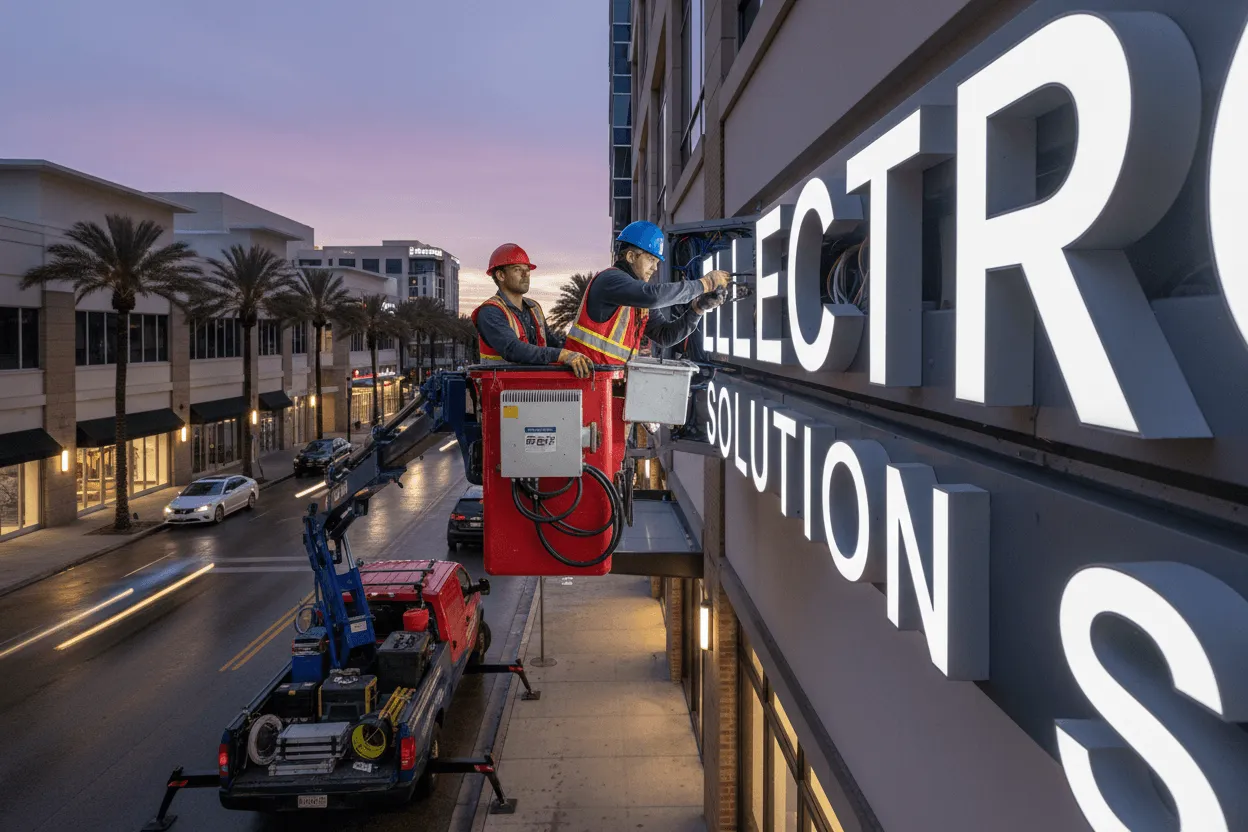
Channel letter lighting installation varies significantly based on letter depth, face material, and mounting method. Most failures stem from inadequate transformer sizing and improper wire gauge selection, not LED module quality. We’ve pulled down plenty of year-old installations where someone spec’d 18-gauge wire for a 60-foot channel letter run and wondered why half the letters went dark within months.
Channel Letter Power and Wiring
Channel letter installations face several technical challenges. Power supply placement matters—mount too far from the sign and voltage drop kills LED performance. Too close and you’re drilling unnecessary penetrations in the building facade. Here’s what separates clean installations from service callbacks:
- LED module wiring runs exceeding 20 feet require voltage drop calculations
- Transformer sizing must account for initial inrush current, not just steady-state draw
- Waterproof connections at every letter require marine-grade heat shrink, not wire nuts
- Raceway paths need approval before you drill—Carmel’s historic overlay districts require matching colors
- Ground fault protection belongs at the power source, not individual letters
Channel letter installations in Carmel’s commercial corridors face stricter photometric standards than most Indiana municipalities, requiring pre-installation light spillage calculations. The City Center area enforces foot-candle limits at property lines that affect LED module selection.
Monument Sign Lighting Access and Maintenance
Monument sign lighting creates service access challenges that cabinet signs don’t. Ground-level installations attract moisture, landscaping debris, and occasional vehicle impact. Your service partner needs removable access panels positioned where irrigation won’t flood the electrical compartment. LED strip lighting works better than individual modules for monument applications—fewer failure points and simpler retrofits.
Cabinet Sign Retrofit Considerations
Cabinet sign illumination retrofits require transformer compatibility verification before you order LED modules. The existing ballast infrastructure might not play nicely with LED drivers. We’ve opened cabinet signs in Hamilton County where three different lighting technologies were layered over 20 years—fluorescent ballasts still wired, HID sockets capped off, and failing LED strips zip-tied to the interior frame.
Planning a sign lighting retrofit or new installation in the Indianapolis metro? Our team provides detailed project surveys and timeline estimates at no charge for qualified partners. Reach us at (317) 800-6500 or toll-free (877) 681-7446.
Parking Lot and Canopy Lighting for Multi-Location Commercial Properties
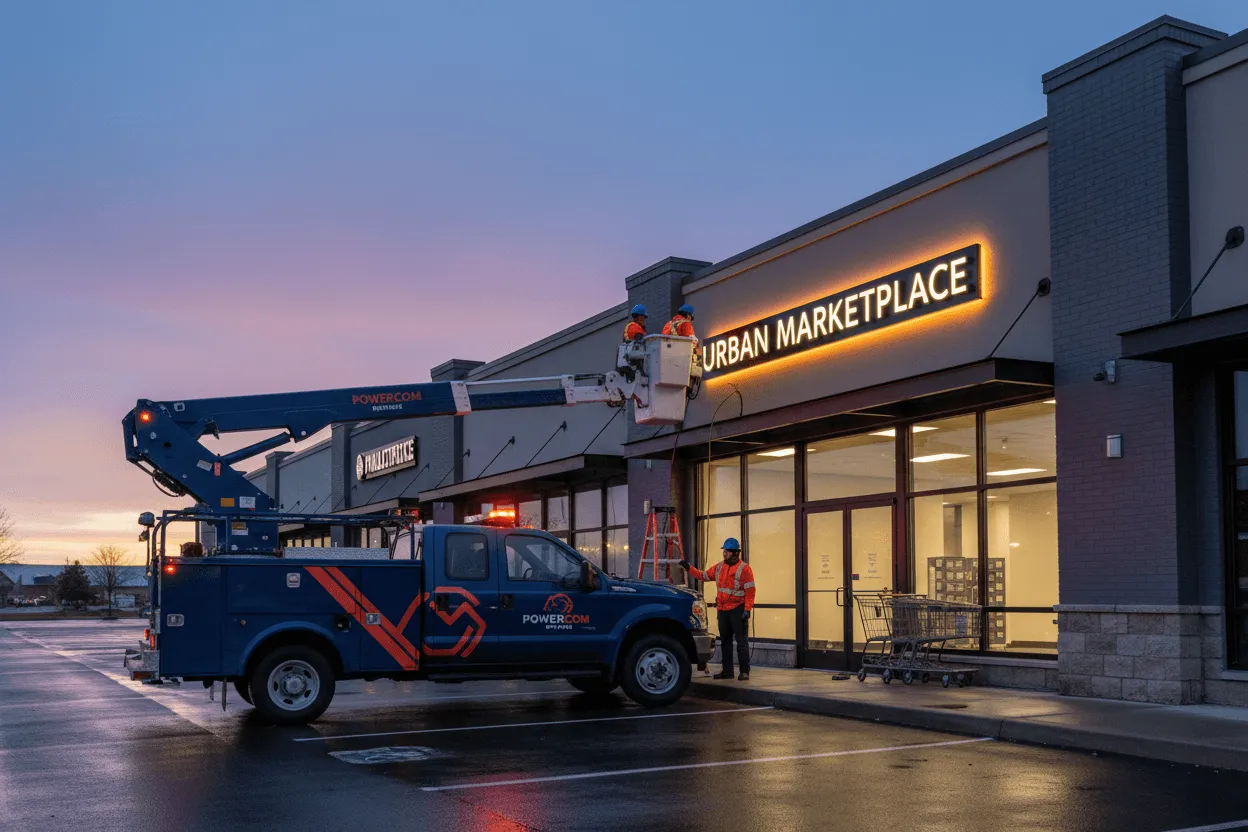
Facilities managers running regional rollouts quickly learn that parking lot lighting coordination separates responsive service partners from those who deliver excuses. When you’re scheduling lighting signage installation in Carmel, IN across three retail locations in the same week, you need a crew that understands photometric compliance and utility coordination—not just fixture installation.
Parking Lot Lighting Codes and Coverage
Parking lot lighting in commercial districts like Keystone at the Crossing requires foot-candle measurements that meet IES standards. Most jurisdictions require 1.0 to 2.0 foot-candles in active parking areas and 0.2 foot-candles minimum at property perimeters. But here’s what project managers often miss: photocell integration requires utility provider coordination before your inspection.
A properly installed parking lot lighting system with LED fixtures in 2026 should include surge protection and individual circuit control to maximize uptime for 24-hour retail operations. We coordinate photocell wiring with Duke Energy and IPL ahead of final inspection, which keeps your timeline on track.
Gas Station Canopy Requirements
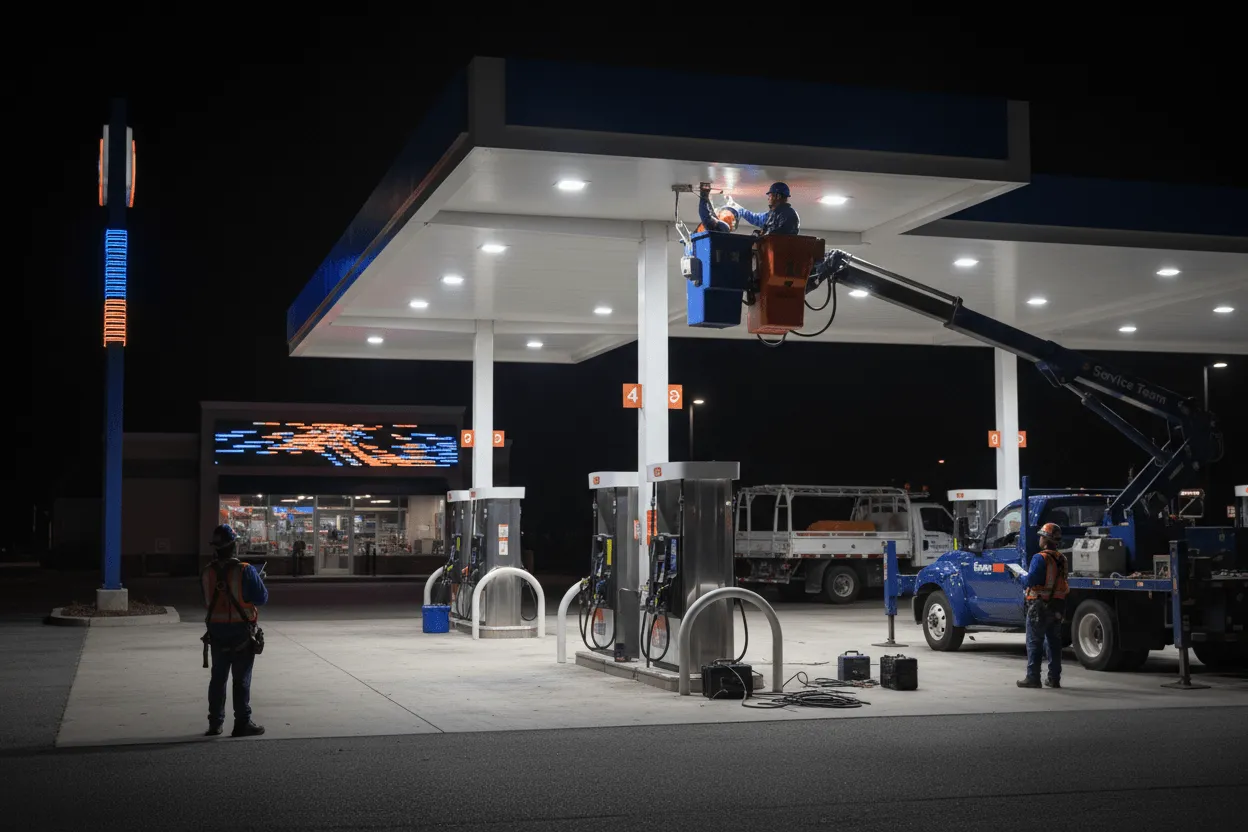
Gas station canopy lighting demands explosion-proof fixtures rated for Class I Division 2 environments. Emergency power requirements vary by fuel dispenser configuration, and most jurisdictions require backup battery systems that maintain 50% illumination during power failures.
Parking lot and canopy lighting projects require coordination with utility providers for photocell integration and emergency power compliance—a step many installers overlook until inspection. Our commercial lighting installation crews handle permit coordination alongside your sign projects, which reduces your site visits and accelerates your regional deployment schedules.
Partner with Midwest Signs for Your Carmel Sign and Lighting Projects
National sign companies and facilities managers need a service partner who understands Carmel’s stringent regulations and responds when projects demand it. We’ve built our reputation across the Indianapolis metro area by combining 40+ years of experience with multi-state licensing and responsive project coordination. When you’re managing installations across Indiana, Illinois, Ohio, and Kentucky, you need a sign installation contractor who handles permits, documentation, and field work as an extension of your team.
Our fleet covers the entire state, and we commit to 24-48 hour response times for both installations and emergency service calls. That matters when you’re coordinating projects for national accounts or managing multi-location rollouts. We handle sign installation Indianapolis metro projects through electronic documentation systems that maintain warranty compliance and project records your clients expect.
Partner with Midwest Signs for your Carmel sign and lighting installation projects. With 40+ years of experience, multi-state coverage, and 24-48 hour response commitments, we serve as an extension of your team. Call (317) 800-6500 or visit our sign service and installation page to discuss your next project.
Frequently Asked Questions: Sign and Lighting Installation in Carmel
Do I need a permit for lighting signage installation in Carmel IN?
Yes, Carmel requires both a sign permit through the Department of Community Services and an electrical permit through Hamilton County for any illuminated signage installation. Projects in the Arts District or City Center design overlay zones also require photometric studies showing light spillage does not exceed 0.5 foot-candles at property lines. We coordinate all permit applications and variance requests as part of our installation service, streamlining the approval process for your sign permits Indianapolis metro projects.
How long does a typical commercial sign lighting installation take in Carmel?
Most channel letter and monument sign lighting installations are completed in 1-2 days once permits are approved. Permit approval in Carmel typically takes 2-3 weeks for standard applications, longer if design review is required. LED retrofit projects on existing signage can often be completed in 4-8 hours depending on sign size and access requirements. Our team provides detailed timeline estimates during the project survey phase so your rollout schedule stays on track.
What’s the difference between channel letter lighting and cabinet sign lighting?
Channel letters are individual illuminated letters mounted to building facades, with LEDs inside each letter creating a halo or face-lit effect. Cabinet signs are single enclosed boxes with translucent faces, illuminated from within by LED modules or strips. Channel letters provide higher visibility and dimensional appeal but require more complex installation and power distribution. Cabinet signs are more economical for larger message areas and easier to retrofit with LED technology.
Can you retrofit existing signs with LED lighting in Carmel without replacing the entire sign?
Yes, most channel letters, cabinet signs, and monument signs can be retrofitted with LED lighting modules while keeping existing cabinets and structures. Based on our experience across the Indianapolis metro area, LED retrofits typically reduce energy consumption by 60-75% and maintenance calls by 80% compared to fluorescent or neon. Carmel may require updated permits for retrofit work depending on whether electrical load changes significantly. We evaluate existing sign condition during surveys to determine if retrofitting is more economical than replacement.
Do you handle parking lot lighting installation along with sign lighting in Carmel?
Yes, Midwest Signs provides complete commercial lighting services including parking lot lighting, building facade lighting, and gas station canopy lighting throughout the region. Many of our service partners coordinate sign and parking lot lighting projects simultaneously for efficiency. We handle photometric calculations, utility coordination, and permit applications for all commercial lighting work in Carmel and Hamilton County.
What documentation do national sign companies need for warranty compliance on Carmel installations?
Service partners typically require completed installation checklists, electrical inspection approval certificates, photometric test results, and as-built photos showing final installation details. Our field crews use paperless electronic documentation systems that deliver all required paperwork within 24-48 hours of project completion. We also maintain detailed records of all installations for future service calls and warranty claims, which is critical for multi-location rollouts where consistency matters.