


Direct Answer
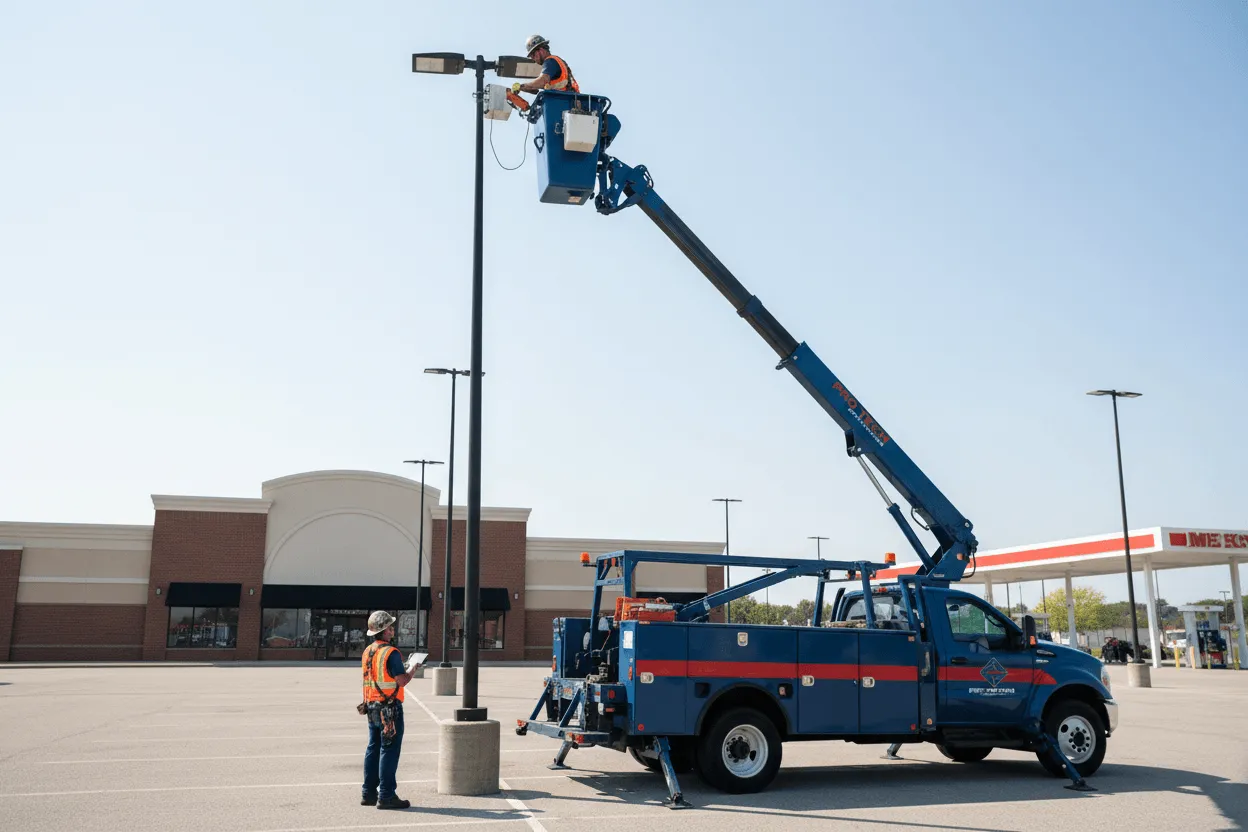
Commercial lighting repair in Indianapolis addresses parking lot and canopy lighting failures caused by photocell malfunctions, ballast or LED driver issues, and moisture-related component damage. Midwest Signs provides comprehensive commercial lighting repair throughout Indianapolis with systematic diagnostic processes and 24-48 hour response times. Our service teams cover multi-location canopy lighting at gas stations, retail parking lot systems, and illuminated signage throughout Indiana, Illinois, Ohio, and Kentucky for national sign companies and facilities management partners.
Why Do Parking Lot and Canopy Lights Fail?
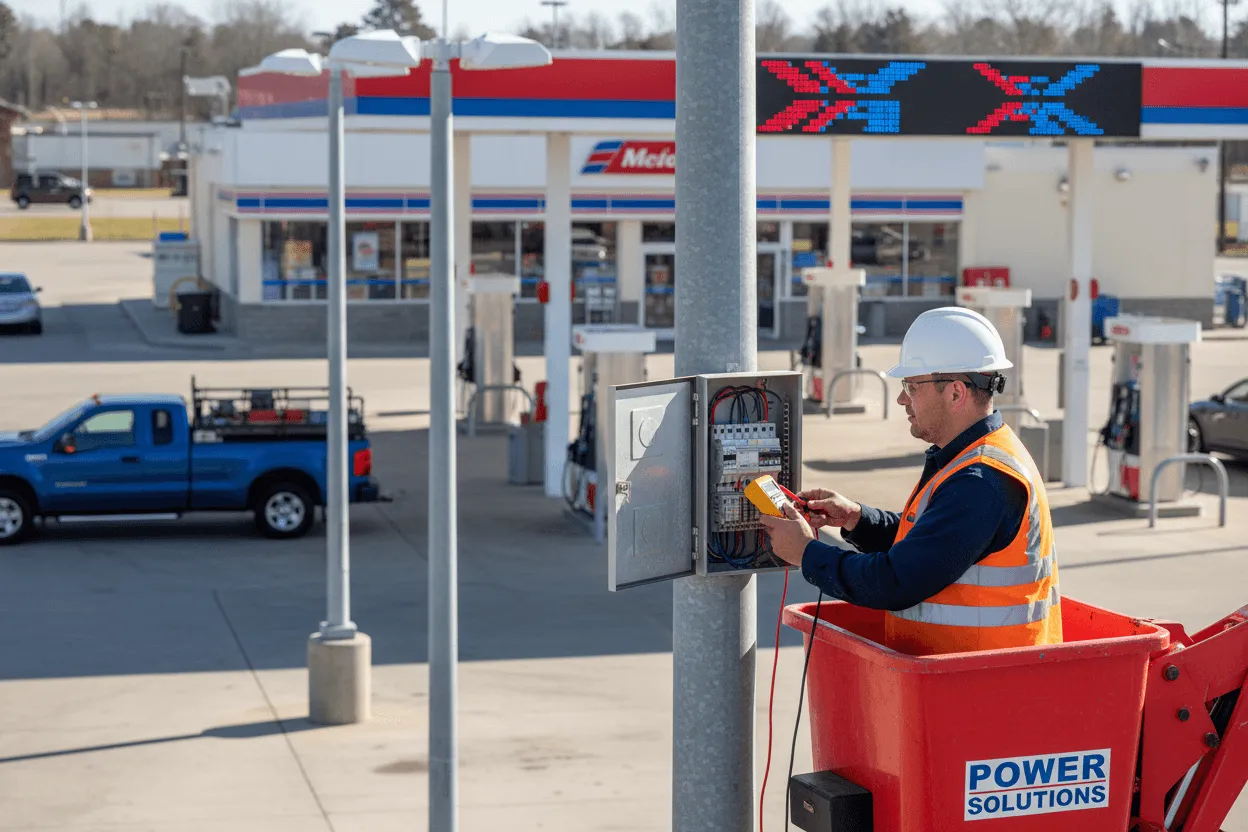
Parking lot and canopy lighting failures fall into three diagnostic categories: control system malfunctions, electrical supply issues, and fixture component degradation, each requiring different repair approaches. Most outages you’re facing aren’t actually about failed bulbs—they’re about the systems that power and control those lights breaking down under constant exposure to Indiana weather.
Based on our experience serving Indianapolis commercial properties, photocell failures account for approximately 60% of parking lot lighting outages. These light-sensing controls get hammered by freeze-thaw cycles we see every winter, then baked by summer heat. One retail property manager on Pendleton Pike called us about an entire parking field staying dark—turned out three separate photocells had failed within the same week during last March’s temperature swings.
Control System Failures
Photocells aren’t the only control vulnerability. Contactors stick in the open position. Timer mechanisms drift or fail completely. When your canopy lights stay on all day or won’t activate at dusk, you’re looking at control issues that need commercial lighting repair expertise to properly diagnose.
Power Supply and Wiring Issues
Ballast failures in older HID systems and LED driver burnouts create sudden outages. But wiring problems develop gradually—connections corrode, wire insulation degrades from UV exposure, junction boxes let in moisture. These canopy light problems often affect multiple fixtures in a circuit pattern.
Fixture Component Degradation
Even LED systems face component wear. Drivers fail from thermal stress. Moisture intrusion corrodes internal connections. We’ve pulled apart canopy fixtures at gas stations where water had been pooling inside for months, slowly destroying every electrical connection. That’s not a bulb replacement—that’s a commercial lighting installation and service situation requiring fixture replacement.
Diagnosing Photocell and Control System Problems
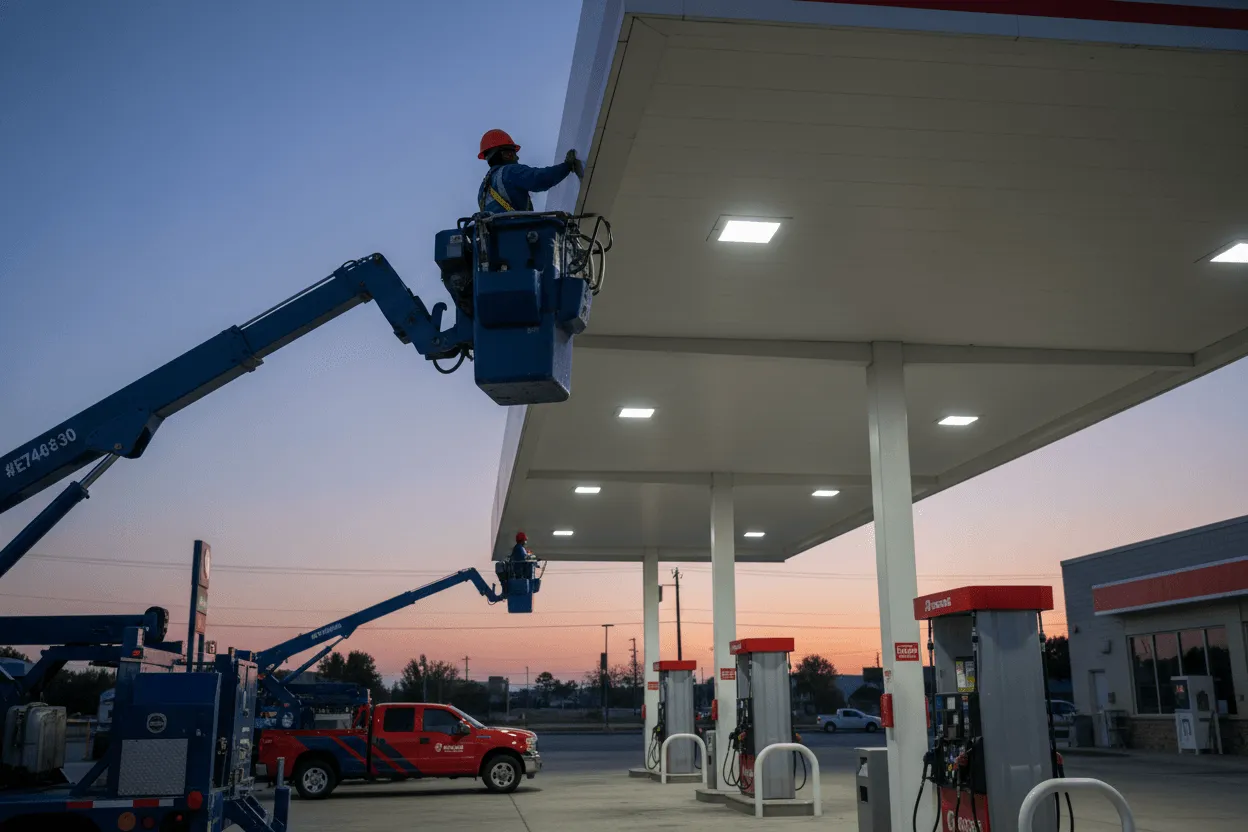
A photocell is a light-sensing control device that automatically activates parking lot lighting at dusk and deactivates at dawn, eliminating manual switching and reducing energy waste. Photocell failures account for approximately 60% of parking lot lighting outages in commercial properties, typically caused by moisture intrusion or voltage spikes rather than normal wear. Parking lot lighting systems with failed photocells consume an estimated 30-40% more energy annually by running during daylight hours, based on our experience serving facilities management clients across the Indianapolis region.
Testing Photocell Operation
Photocell troubleshooting starts with voltage testing at the device terminals. You’ll see three wires: line voltage input, switched output, and neutral. Test with the photocell exposed to light—you should read zero volts from switched output to neutral. Cover the sensor completely and retest within 30 seconds. A functioning photocell will show line voltage on the switched output.
Don’t replace a dirty photocell. We’ve seen controllers with years of service left that just needed cleaning. Wipe the sensor lens with a soft cloth and isopropyl alcohol, then retest. If voltage measurements show proper switching but lights still fail, the issue’s downstream in your parking lot lighting controls.
Identifying Control Panel Issues
Multiple fixture failures point to control components rather than individual lamps. Check contactors and relays in your lighting panel for visible pitting on contacts or a burnt smell. These components handle high-amperage switching cycles and wear faster in gas station canopy applications where lights cycle more frequently.
| Symptom | Likely Cause | Test Method |
|---|---|---|
| All fixtures dark at night | Failed photocell or contactor | Voltage testing at photocell output |
| Lights stay on 24/7 | Stuck contactor or bypassed photocell | Check for manual override switches |
| Random section outages | Loose wiring or faulty relay | Voltage drop testing at junction boxes |
Voltage Drop Testing in Supply Circuits
Systematic voltage testing from service panel to fixture is the only reliable method to isolate whether failures originate in supply circuits, control components, or the fixtures themselves. Measure voltage at the panel breaker, then at each junction box toward the fixture. A drop exceeding 5% indicates resistance from corroded connections or undersized conductors—common in older Indianapolis parking lot lighting installations where expansion outpaced original circuit capacity.
Experiencing unexplained parking lot lighting failures? Our diagnostic process identifies the root cause, not just the symptoms. Contact Midwest Signs for a systematic lighting assessment.
Ballast and LED Driver Failures in Canopy Lighting
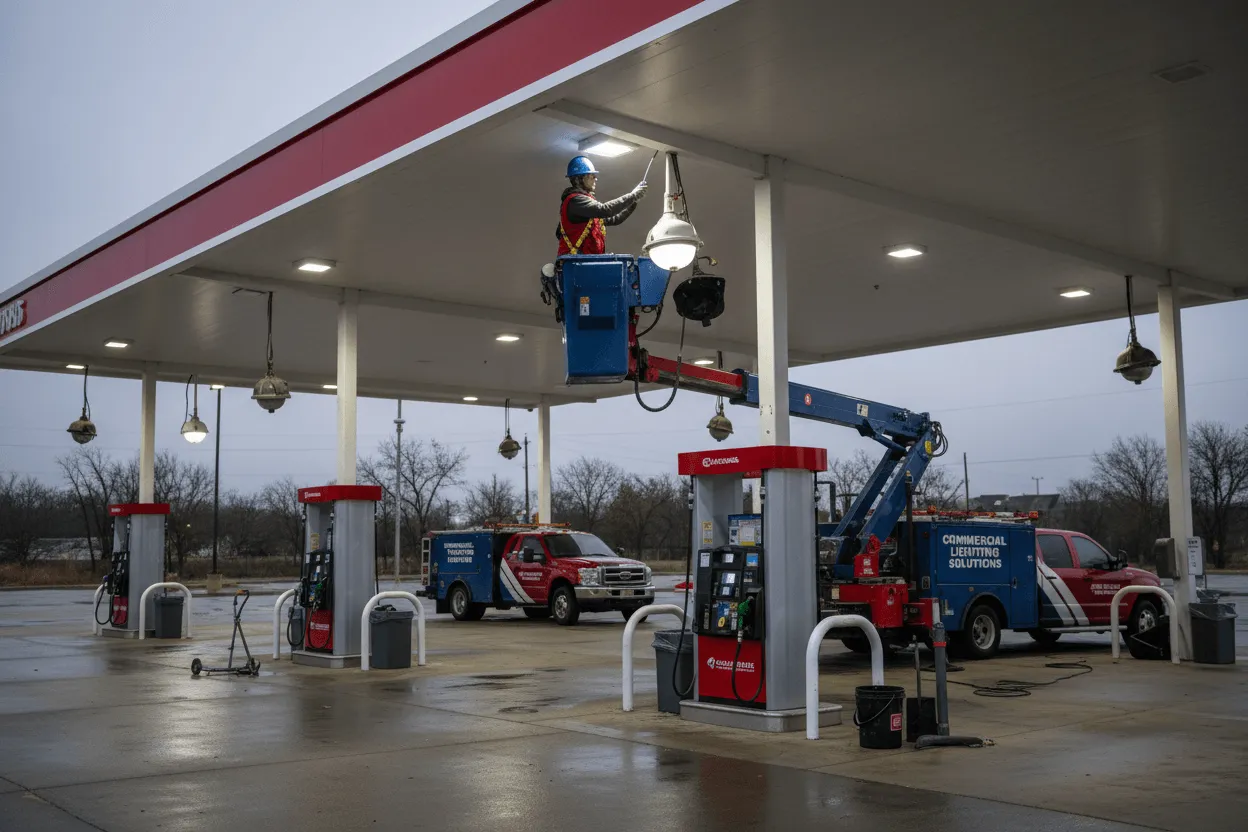
A ballast is an electromagnetic or electronic component that regulates current flow to HID and fluorescent lamps, while an LED driver converts AC voltage to the DC current LED arrays require. Understanding the difference between ballast and LED driver failures is critical because diagnostic procedures and replacement considerations differ significantly between legacy and modern lighting systems.
HID Ballast Troubleshooting
HID ballasts fail in predictable patterns. You’ll notice flickering during warmup, delayed ignition that takes several minutes, or a distinct humming sound that indicates magnetic core deterioration. Complete ballast failure means the lamp won’t ignite at all. Testing requires a multimeter to verify output voltage—most HID ballasts should deliver 120-277V depending on fixture specifications.
Here’s what matters: replacing one failed ballast in a multi-lamp canopy often reveals hidden issues. A single failed ballast in a multi-lamp canopy fixture can create a cascading failure pattern where functioning lamps cycle on and off, reducing the lifespan of adjacent fixtures by up to 40%. We diagnose this constantly at Indianapolis-area gas stations where multiple canopy lamps share electrical circuits.
LED Driver Diagnostics
LED driver failures look different. Instead of delayed starts, you get instant failure—the lamp array either works or it doesn’t. Partial dimming or color shifting indicates driver degradation rather than complete failure. Voltage testing on the output side should show consistent DC current matching the driver’s rated specification, typically 24-48V DC for commercial canopy systems.
Recognizing Cascading Failure Patterns
One failed component stresses the entire circuit. When a ballast fails, adjacent fixtures compensate by drawing additional current, which accelerates their thermal degradation. This is why canopy lighting repair often reveals multiple compromised components even when only one lamp failed initially.
| Symptom | HID Ballast Failure | LED Driver Failure |
|---|---|---|
| Flickering | During warmup, gradual worsening | Rare; indicates imminent failure |
| Delayed Start | Common, extends over weeks | Not applicable—instant on/off |
| Complete Failure | Lamp won’t ignite | No light output at all |
| Audible Noise | Humming from magnetic components | Silent failure |
When LED Retrofit Solves Recurring Commercial Lighting Repair Issues
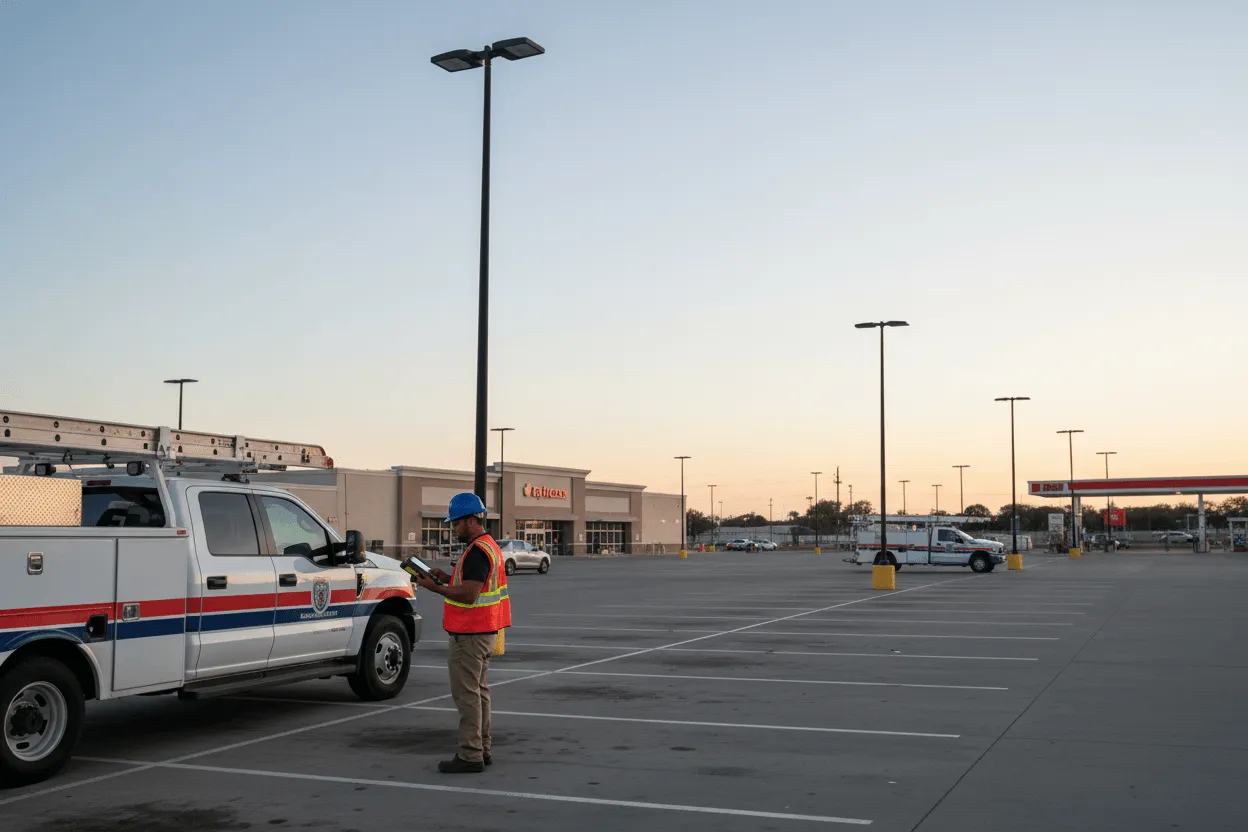
You’re scheduling another photocell replacement for the same gas station canopy you’ve already serviced twice this year. That’s the cycle with aging high-intensity discharge systems—they become service revenue generators, not solutions. Based on our experience serving national sign company partners across the Indianapolis metro area, properties with metal halide or high-pressure sodium fixtures average 4-6 commercial lighting repair calls annually compared to fewer than one call per year for LED systems.
Calculating the Cost of Repeated Repairs
A typical ballast failure service call—$350-$450 including labor, parts, and lift rental—seems reasonable until you’re scheduling them quarterly. Over 18 months, properties requiring ballast replacements every 12-18 months accumulate $1,200-$1,800 in reactive maintenance costs. And that’s just direct repair expenses. Factor in tenant complaints, potential liability from dark parking areas, and the administrative burden of scheduling multiple service appointments.
LED retrofit projects reduce maintenance call frequency by approximately 70% compared to metal halide and high-pressure sodium systems. That dramatic reduction stems from eliminating failure-prone ballasts entirely and reducing component count by consolidating multiple parts into integrated LED arrays with solid-state drivers.
How LED Systems Reduce Failure Points
Traditional HID fixtures contain ballasts, igniters, capacitors, and photocells—each a potential failure point. LED systems consolidate these functions into drivers and control modules with typical lifespans exceeding 100,000 hours. Properties experiencing commercial lighting repair calls more than twice annually should evaluate LED retrofit economics, as reduced maintenance costs often justify conversion within 18-24 months.
The 2026 generation of commercial-grade LED modules delivers improved driver efficiency and thermal management, extending service intervals even further. Combined with LED retrofit signage upgrades, facilities can reduce total exterior lighting maintenance commitments significantly.
Tired of recurring commercial lighting repair calls? Let’s evaluate whether LED retrofit and lighting upgrades make financial sense for your property. Midwest Signs provides transparent cost comparisons and ROI projections.
Commercial Lighting Repair Response for Multi-Location Facilities
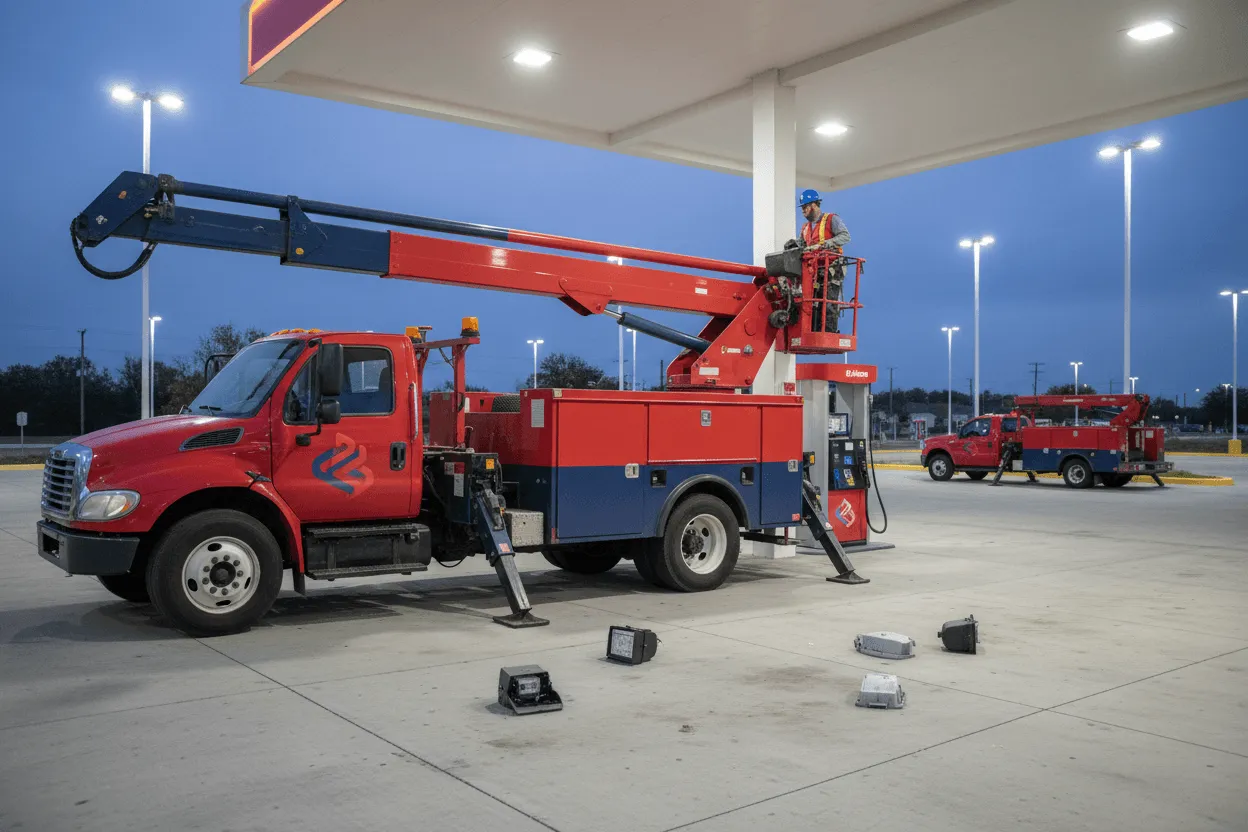
Facilities managing multiple locations require commercial lighting repair partners with consistent documentation systems, regional coverage, and the capacity to coordinate simultaneous repairs across properties. When you’re overseeing twenty retail sites across Indiana, you can’t rely on individual contractors who handle each location differently.
We’ve built our commercial lighting maintenance processes specifically for procurement managers and facilities directors who need standardized reporting. Every service call generates electronic documentation with timestamped photos, diagnostic findings, and parts replaced—all delivered through our paperless system that integrates with most facilities management platforms. You get the same detailed report format whether we’re servicing a gas station in Castleton or a retail center off I-465 near Greenwood.
Commercial lighting repair response times in Indianapolis average 24-48 hours for non-emergency situations, but facilities with safety or security concerns should expect same-day service from qualified providers. We maintain that response commitment across Indiana because we’ve structured our team specifically for multi-location lighting service coordination.
Here’s what matters for chain properties: simultaneous repairs across multiple sites require more than just availability. Commercial properties in the Indianapolis I-465 corridor average 15-20 parking lot light poles requiring coordinated photocell replacement every 3-4 years, based on our experience serving regional facilities. Managing that efficiently means:
- Regional coverage across Indiana for coordinated service dates
- Consistent diagnostic standards across all properties
- Electronic work orders that sync with your existing facilities management software
- Single-point contact coordination for all locations
- Priority scheduling for properties with compromised security lighting
Our parking lot and canopy lighting service model supports national sign companies and facilities management firms who need reliable documentation and predictable response times across multiple Indiana properties.
Partner With Midwest Signs for Indianapolis Commercial Lighting Repair
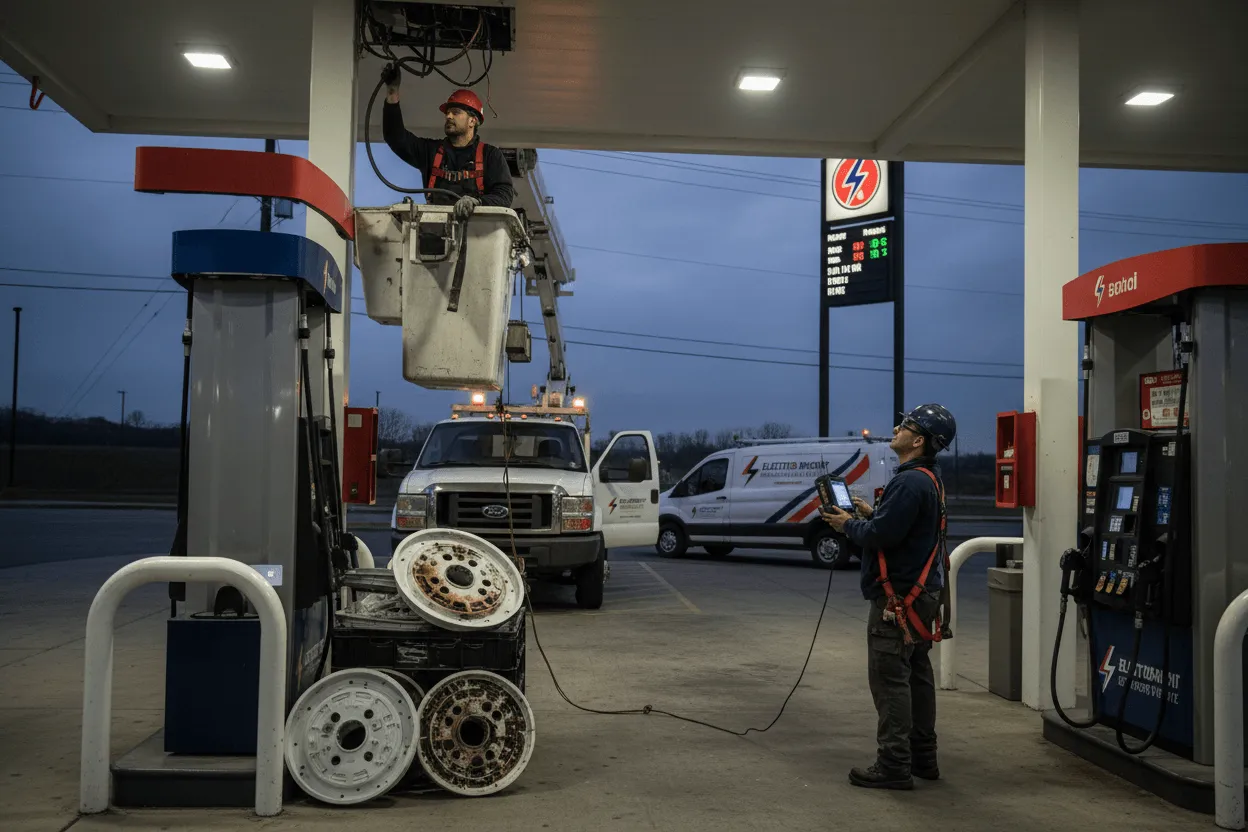
Since 1988, we’ve diagnosed and restored parking lot lighting, canopy systems, and exterior signage illumination across Indianapolis and the surrounding region. Our diagnostic approach addresses the entire system architecture—not just swapping out failed components—which prevents recurring service calls and keeps your clients’ properties lit reliably.
As a preferred service partner for national sign companies and regional facilities management firms, we understand the coordination and documentation requirements of multi-location agreements. You get 24-48 hour response times, electronic field reporting, and the accountability that comes from four decades serving Indiana, Illinois, Ohio, and Kentucky.
Proper commercial lighting repair requires understanding the entire system architecture, not just replacing failed components, to prevent recurring failures. That’s the difference between a one-time fix and a lasting solution.
Partner with Midwest Signs for responsive, professional commercial lighting installation Indianapolis and repair service throughout central Indiana. Call (317) 800-6500 or reach our team at 5335 E Stop 11 Road in Indianapolis to discuss your lighting service challenges.
Frequently Asked Questions About Commercial Lighting Repair
How much does commercial lighting repair cost in Indianapolis?
Commercial lighting repair costs vary based on the issue: photocell replacements typically run $75-150 per unit, ballast or LED driver replacements range from $150-400 per fixture depending on system type, and complete fixture replacements start around $300-600 for parking lot poles. Properties requiring multiple repairs or bucket truck access will see higher project costs. Midwest Signs provides detailed assessments with transparent pricing before work begins, so you’ll know exactly what your multi-location portfolio will need.
What causes parking lot lights to stay on during the day?
Parking lot lights that run continuously during daylight hours indicate photocell failure or wiring issues in the control circuit. The photocell sensor has either failed internally, accumulated dirt or debris blocking proper light detection, or lost its ground connection. In some cases, someone has bypassed the photocell intentionally. This not only wastes 30-40% more energy annually but accelerates lamp and fixture wear—a costly situation when you’re managing dozens of sites across the Midwest.
How long does commercial lighting repair take in Indianapolis?
Most commercial lighting repair projects in Indianapolis are completed within 24-48 hours from initial contact, with many single-fixture repairs handled same-day if parts are in stock. Multi-fixture projects at large properties may require 2-3 days for coordination and completion. Emergency situations affecting safety or security receive priority response, often within 4-6 hours. Midwest Signs maintains local inventory of common components to minimize downtime for your retail and restaurant chains.
Should I repair or replace old parking lot lights?
If your parking lot lighting system is over 10 years old and requires frequent repairs, replacement with LED fixtures usually provides better long-term value. Legacy HID systems with recurring ballast or photocell failures every 12-18 months accumulate repair costs that often exceed LED retrofit investment within 2-3 years. However, newer fixtures with isolated component failures are typically cost-effective to repair rather than replace—something we evaluate honestly on every service call.
Do you provide emergency commercial lighting repair?
Yes, Midwest Signs offers priority response for commercial lighting emergencies affecting safety, security, or business operations. Properties with complete lighting outages in parking areas, entryways, or under canopies receive same-day service when contacted during business hours, with 24-hour response for after-hours emergencies. We maintain service vehicles throughout Indianapolis and surrounding areas for rapid deployment to urgent situations at your branded locations.
What’s the difference between ballast and LED driver failure?
Ballasts power traditional HID and fluorescent lamps and typically fail with visible symptoms like loud humming, flickering, or delayed lamp ignition before complete failure. LED drivers fail more suddenly, usually causing complete outage or erratic dimming and color shifting. LED drivers are also more sensitive to voltage fluctuations and require different diagnostic testing. Both components are fixture-specific and not interchangeable between lighting technologies.