


Direct Answer
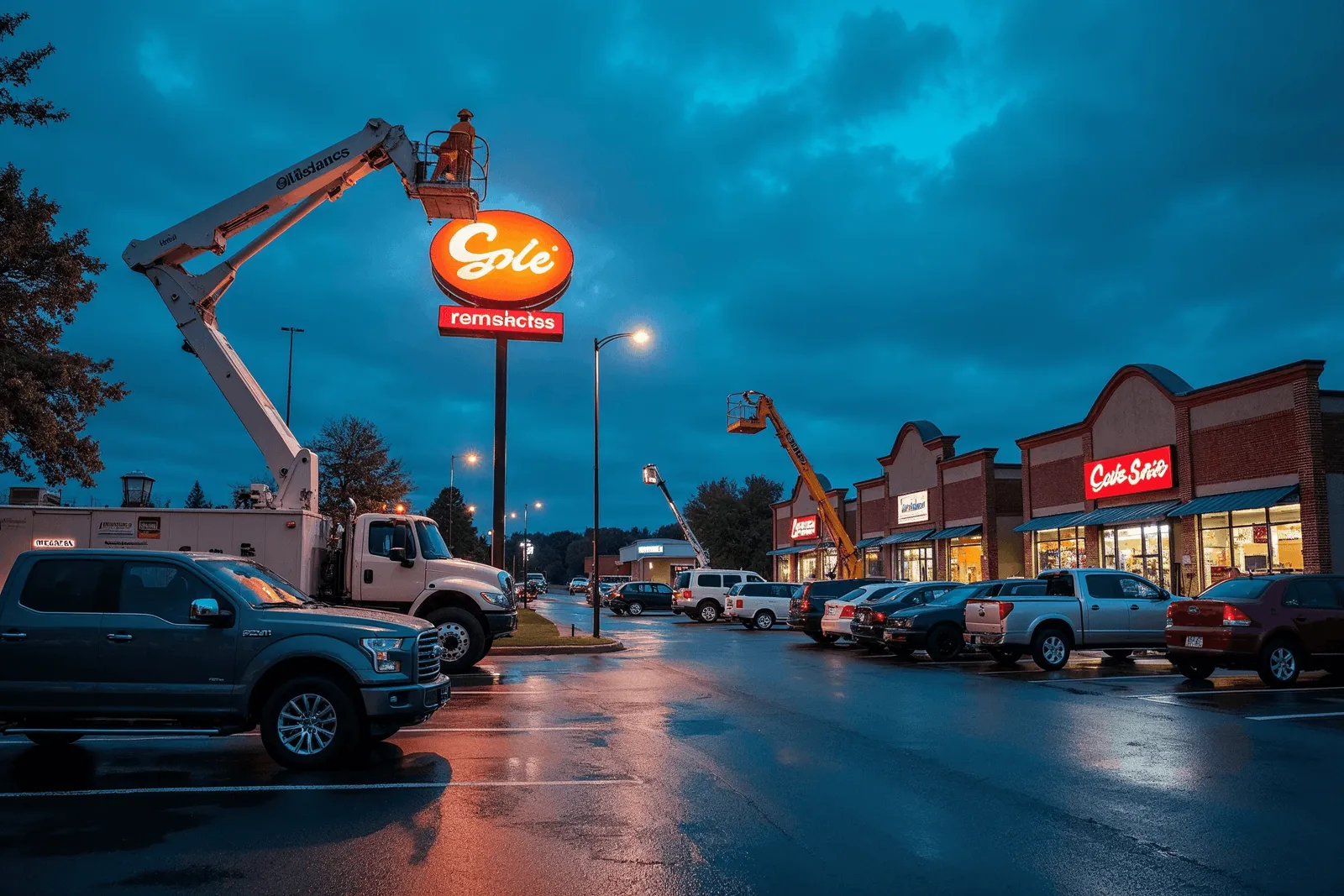
An LED retrofit is a conversion of existing commercial exterior lighting systems to LED technology that delivers immediate energy savings and extended lifespan. Exterior lighting LED retrofits for commercial properties reduce energy costs 50-70% while extending fixture lifespan to 50,000+ hours. We upgrade parking lot lighting, gas station canopies, and building facades across Indianapolis and the surrounding Indiana region with 24-48 hour response times. Our team coordinates multi-site LED retrofit signage projects for national accounts partners requiring consistent installation standards.
Why LED Retrofits Make Financial Sense for Commercial Exterior Lighting in 2026
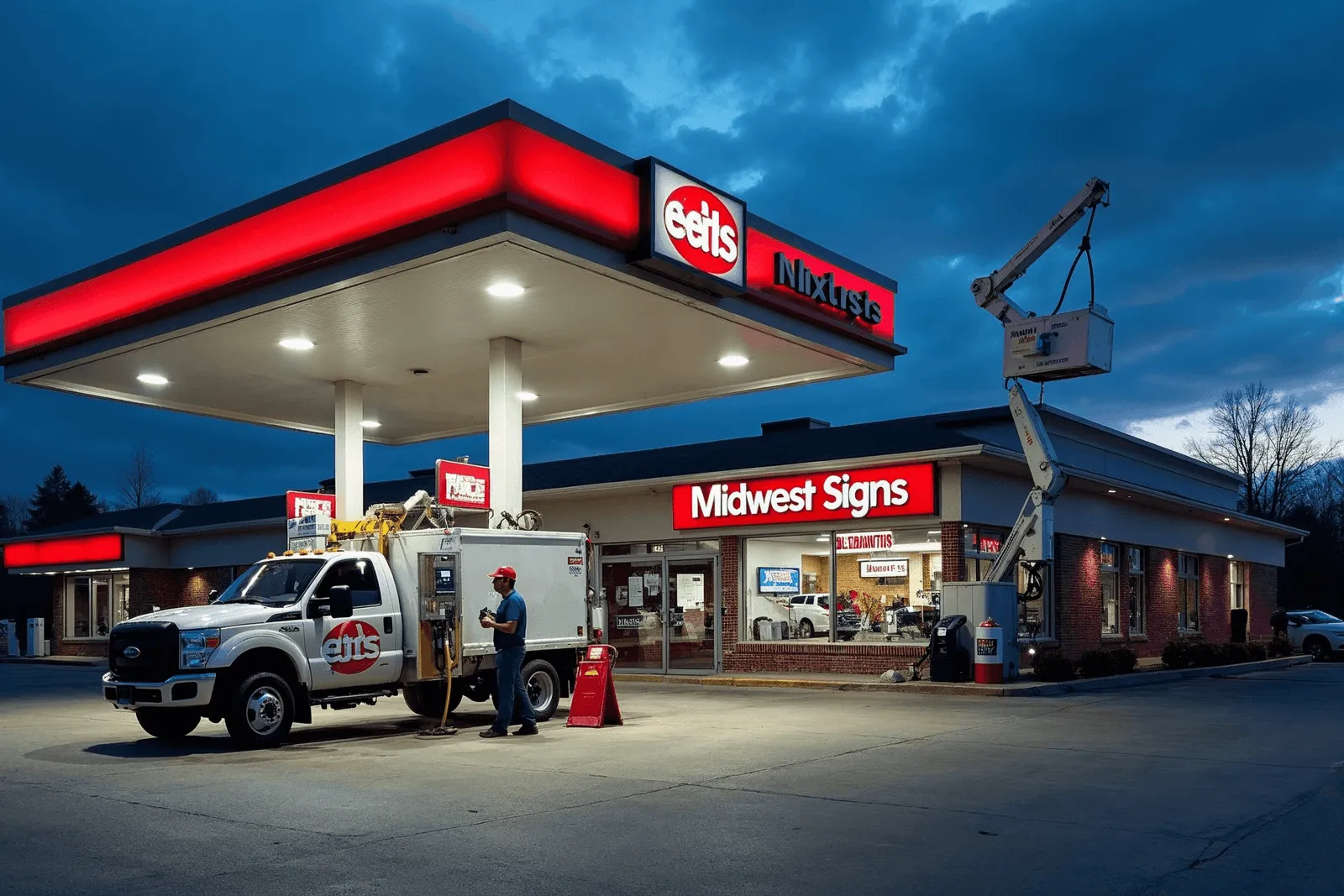
An LED retrofit is the conversion of existing metal halide, high-pressure sodium, or fluorescent commercial exterior lighting to LED technology that reduces energy consumption and maintenance requirements. For procurement managers evaluating lighting upgrades across multi-location portfolios, the numbers drive the decision: commercial exterior lighting LED retrofits typically reduce energy consumption by 50-70% while extending fixture lifespan from 10,000 hours to 50,000+ hours.
Energy Savings That Show Up Immediately on Utility Bills
A 400-watt metal halide parking lot fixture draws closer to 465 watts with ballast losses. The LED equivalent delivers the same lumens at 150 watts. Multiply that across twenty poles running twelve hours nightly, and you’re looking at substantial monthly reductions. Indiana utility rebates cover 20-40% of LED retrofit costs in 2026, which accelerates ROI significantly.
We completed a retrofit last year for a regional gas station chain with forty-three locations across central Indiana. Their 24/7 canopy lighting was hemorrhaging electricity. The payback period hit eighteen months, and maintenance calls dropped by 80% in the first year.
Maintenance Cost Reductions That Procurement Managers Actually Notice
Metal halide lamps fail constantly. You’re sending crews up lifts, coordinating access, replacing ballasts. LED fixtures run five times longer with far fewer component failures. Honestly, most facilities managers don’t calculate the true cost of maintenance until they see service invoices stacked up.
| Lighting Type | Typical Payback | Energy Savings |
|---|---|---|
| Parking Lot (Poles) | 2-4 years | 60-65% |
| Canopy (24/7) | 1-2 years | 65-70% |
| Building Façade | 3-5 years | 50-60% |
Midwest Signs provides detailed ROI analysis for LED retrofit projects across Indiana and adjacent states. Contact our team at commercial lighting installation to discuss your multi-location lighting upgrade needs.
Commercial Exterior Lighting Applications: Which Retrofits Deliver the Best ROI?
Not all LED conversion opportunities deliver the same payback. When national sign companies and facilities managers ask us which retrofits to prioritize, we point to five commercial exterior lighting applications that consistently prove their value:
- Gas station canopy lighting operating 24/7 with 80-120 lumens per square foot requirements
- Parking lot pole lighting with 20-40 foot pole heights and comprehensive area coverage
- Building façade and entrance lighting balancing architectural CRI with energy efficiency
- Walkway and safety lighting meeting IES standards and reducing liability exposure
- Perimeter and security lighting integrating motion sensors with strategic coverage patterns
Gas Station Canopy Lighting: The Highest ROI Retrofit Opportunity
Gas station canopy lighting represents one of the highest ROI retrofit opportunities because most stations operate lights 24/7/365, making the energy savings immediate and substantial. We typically see payback periods of 18-24 months across our Central Indiana projects. But here’s what catches teams off guard: driver compatibility can kill an otherwise solid retrofit.
Driver compatibility is the electrical component matching LED fixtures to existing power supplies that determines fixture lifespan and performance. Based on our experience with gas station canopy lighting retrofits, wrong driver selection accounts for 60% of premature failures we’re called to restore. Most canopy retrofits need dedicated drivers rated for continuous operation, not standard commercial-grade components.
Parking Lot Lighting: Coverage Requirements and Pole Height Considerations
Parking lot lighting retrofits deliver strong ROI when you match fixture output to existing pole infrastructure. Properties with 30-40 foot poles need fixtures producing 15,000-25,000 lumens to maintain adequate footcandles at ground level. We partner with national sign companies on multi-location parking lot lighting upgrades where consistent coverage standards matter more than fixture brand.
Building Entrance and Façade Lighting: Balancing Aesthetics and Efficiency
Building facade lighting requires higher CRI ratings—typically 80+ versus 70 for parking areas—to render colors accurately. Your project managers know this matters when corporate brand standards dictate specific color temperatures and rendering quality for architectural illumination.
Technical Specifications: What Project Managers Need to Know About LED Retrofit Installation

LED driver compatibility determines whether your retrofit lasts three years or fifteen. Universal LED bulbs promise plug-and-play convenience, but when you install them in fixtures originally designed for metal halide ballasts, thermal management becomes a serious challenge. Enclosed fixtures trap heat that degrades LED arrays prematurely—we’ve replaced installations that failed within eighteen months because the driver couldn’t handle the enclosed environment.
Driver Selection: Why This Makes or Breaks Your Retrofit Project
Three driver options exist for commercial exterior lighting retrofits:
- Ballast bypass: Most reliable for long-term performance, eliminates legacy components
- Direct-wire LED arrays: Purpose-built for enclosed fixtures with integrated thermal protection
- Universal bulbs: Convenient but prone to premature failure in high-heat applications
- Smart drivers with 0-10V dimming: Essential for facilities requiring automated control integration
For gas station canopy lighting and parking lot applications across the Indianapolis region, we specify IP65-rated drivers with surge protection. Color temperature selection matters too—4000K to 5000K works best for commercial applications where visibility and security are priorities, not ambiance.
Footcandle Requirements and IES Compliance for Commercial Properties
Footcandle requirements are illumination standards measured in lumens per square foot that determine whether your parking lot lighting service meets safety and visibility codes. Parking lot lighting retrofits must maintain minimum footcandle requirements per IES standards—typically 1.0 fc minimum for active parking areas and 5.0 fc for building entrances.
Proper driver selection and thermal management are critical—simply swapping bulbs without addressing these factors leads to premature failure. Warranty coverage varies: some manufacturers cover the LED array for ten years but drivers for only three. That gap matters when you’re managing multi-location rollouts for national accounts.
Coordinating Multi-Location LED Retrofits Across Indiana and Adjacent States

Your national accounts team needs more than a technician with a bucket truck. Regional rollouts demand consistent documentation, standardized installation protocols, and a service partner who understands that your project manager in Phoenix shouldn’t have to babysit 47 installations across the Midwest.
For multi-location rollouts across Indiana and adjacent states, Midwest Signs coordinates LED retrofit installations with 24-48 hour response times and paperless documentation that integrates directly with national sign companies’ project management systems. We recently completed a 47-location retail chain exterior lighting conversion spanning Indiana and Ohio—same fixtures, same mounting procedures, same photo verification process at every site.
Documentation Standards That National Sign Companies Actually Need
Project coordinators don’t want phone calls. They want digital documentation that feeds directly into their tracking systems. Our crews complete electronic site reports with GPS-stamped photos showing before-during-after shots, fixture serial numbers, and photocell orientation. You get PDF reports within 24 hours of completion—no chasing paperwork, no missing invoices three weeks later.
- Pre-installation site assessments with fixture inventory and condition notes
- Photo verification of existing wiring and structural mounting points
- Completion documentation including fixture specs and warranty registration
- Utility rebate paperwork coordination across multiple jurisdictions
Scheduling and Coordination for Multi-Site Projects
We sync with your existing maintenance windows. Gas station canopies get done during off-peak hours. Retail parking lots happen before store opening. Our crews coordinate directly with on-site property managers while keeping your multi-location project coordination team updated through a single point of contact.
Managing a regional LED retrofit rollout? Midwest Signs coordinates multi-location projects with standardized documentation and 24-48 hour response times. Partner with our team for your next lighting upgrade.
Common LED Retrofit Mistakes That Facilities Managers Should Avoid

You’d be surprised how many multi-location rollouts fail because someone skipped the basics. The most expensive LED retrofit mistake is choosing the cheapest universal bulbs without verifying driver compatibility—these installations typically fail within 18-24 months, requiring complete re-work.
The ‘Universal LED Bulb’ Trap That Costs More in the Long Run
Here’s what we see with gas station canopy lighting across Indiana: facilities teams buy “universal” LED bulbs to retrofit 40-year-old fixtures without checking ballast types. Those cheap LEDs burn out within 18 months because they’re running on incompatible drivers. You’ll spend more replacing them twice than investing in quality retrofit kits upfront.
Common retrofit mistakes include:
- Ignoring thermal management in enclosed parking lot fixtures—LEDs need ventilation or they’ll fail prematurely
- Skipping photometric testing before committing to 200-location rollouts
- Overlooking warranty coverage gaps between LED components and existing fixture housings
- Attempting DIY retrofits without understanding driver requirements and power factor issues
Why Test Installations Matter Before Full Rollouts
Test installations with actual fixtures and operating conditions before committing to full multi-location rollouts. We run 30-day pilot installations at representative sites—including extreme conditions like 24/7 canopy lighting—to verify performance. That upfront investment prevents costly mistakes when you’re scaling across 50 properties in the Indianapolis metro area and beyond.
Partner With Midwest Signs for Commercial Exterior Lighting LED Retrofits
We’ve spent 40+ years serving national sign companies and facilities management firms across Indiana, Illinois, Ohio, and Kentucky. That experience means you get responsive commercial lighting installation Indianapolis project managers rely on—24-48 hour response times with paperless documentation that keeps your national accounts moving forward.
We’re a preferred service partner for FASTSIGNS National Accounts and regional firms requiring multi-location coordination. Based on our experience serving national sign companies, projects succeed when you’ve got a single point of contact managing exterior lighting retrofits across four states.
Ready to reduce energy costs and maintenance headaches? Call (317) 800-6500 or contact Midwest Signs for expert commercial exterior lighting LED retrofits across Indiana.
Frequently Asked Questions About Commercial Exterior Lighting LED Retrofits
How long do commercial LED exterior lights last?
Commercial LED exterior lighting fixtures typically last 50,000 to 100,000 hours depending on driver quality and thermal management. In practical terms, that’s 11-22 years of continuous operation, or significantly longer for lights operating only during business hours. Quality matters—fixtures with proper thermal design and industrial-grade drivers reach the higher end of this range. We’ve seen poorly-designed fixtures with inadequate heat dissipation fail at just 30,000 hours.
What is the typical payback period for LED parking lot lighting retrofits?
LED parking lot lighting retrofits in Indiana typically achieve payback in 2-4 years through combined energy savings and reduced maintenance costs, based on our experience across multi-location facilities. Gas station canopy lighting, which operates 24/7, often pays back in 12-24 months. Utility rebate programs in 2026 covering 20-40% of project costs accelerate these payback periods by 6-12 months.
Do LED retrofits require completely new fixtures or just bulb replacements?
LED retrofits can involve bulb-only replacements (retrofit kits), complete fixture replacements, or hybrid approaches depending on existing fixture condition and compatibility. Older fixtures with incompatible ballasts or poor thermal design typically require full replacement for reliable long-term performance. Project managers should request photometric analysis before deciding between approaches—the sign surveys Indianapolis teams conduct often reveal issues invisible from ground level.
Can existing photocells and timers work with LED exterior lighting in Indianapolis?
Most modern photocells and timers work with LED lighting, but older mechanical photocells may malfunction due to LEDs’ low current draw. Smart controls and networked lighting systems offer enhanced functionality including dimming schedules, remote monitoring, and automated failure alerts—features particularly valuable for multi-location facilities management across Indiana.
What warranty coverage should facilities managers expect on commercial LED retrofits?
Commercial-grade LED exterior lighting typically carries 5-10 year warranties, but coverage varies between fixture housing, LED arrays, and drivers. National accounts should verify that warranty terms include labor coverage and that the service partner maintains consistent response capability throughout the warranty period. Driver warranties often differ from LED array warranties.
How do you calculate required lumens for parking lot lighting LED retrofits?
Parking lot lighting calculations require photometric modeling that accounts for pole height, spacing, fixture distribution, and target footcandle levels—typically 1.0 fc minimum for parking areas, 5.0 fc for entrances per IES standards. Simple lumen-per-square-foot estimates often result in under- or over-lighting. Professional site surveys ensure IES compliance and optimal coverage across your portfolio.