


Direct Answer
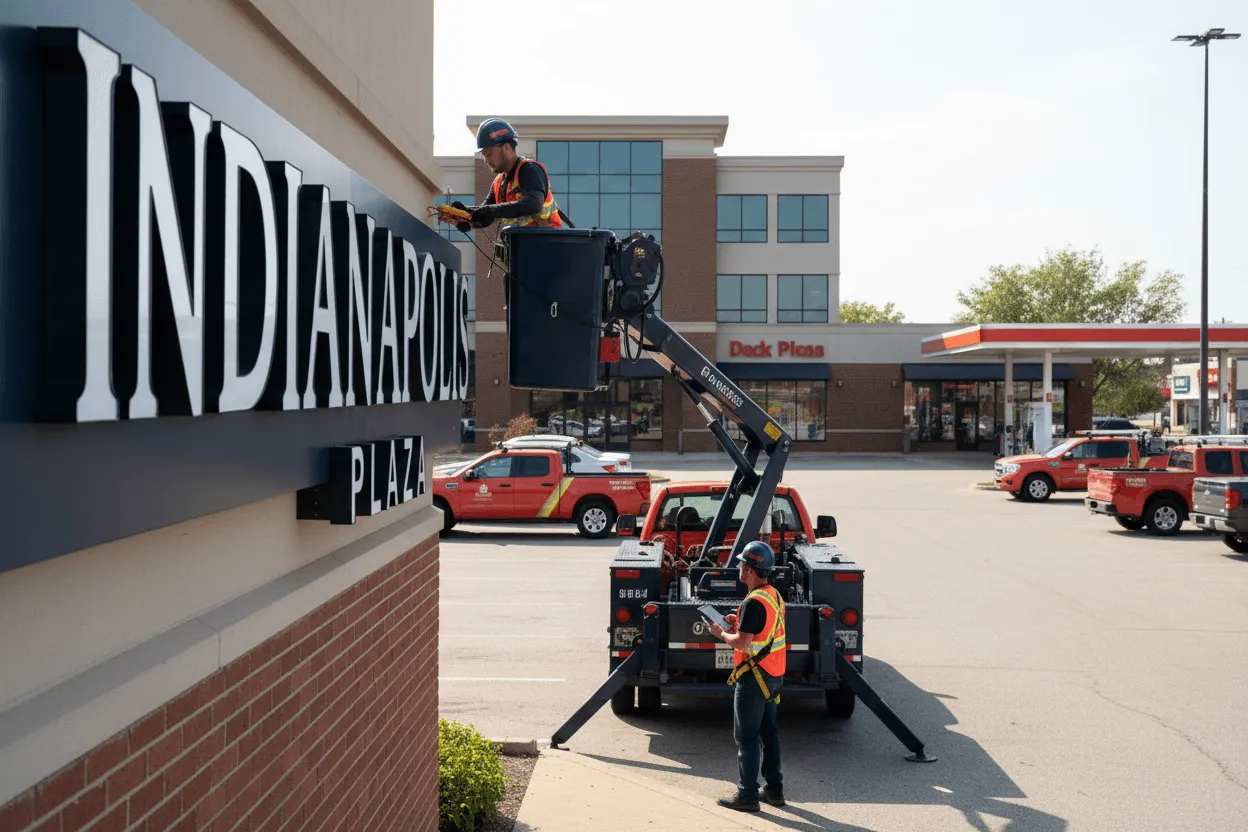
Sign maintenance services in Indianapolis encompass both scheduled preventive care and emergency repair response for commercial signage across all types—channel letters, pylon signs, monument signs, and electronic message centers. Preventive sign maintenance addresses wear items like transformers and LED modules before failure occurs, while emergency sign repair restores operations after outages. Our team delivers 24-48 hour response times across the I-465 corridor for service partners and facilities management firms.
The True Cost Difference Between Preventive Maintenance and Emergency Repairs
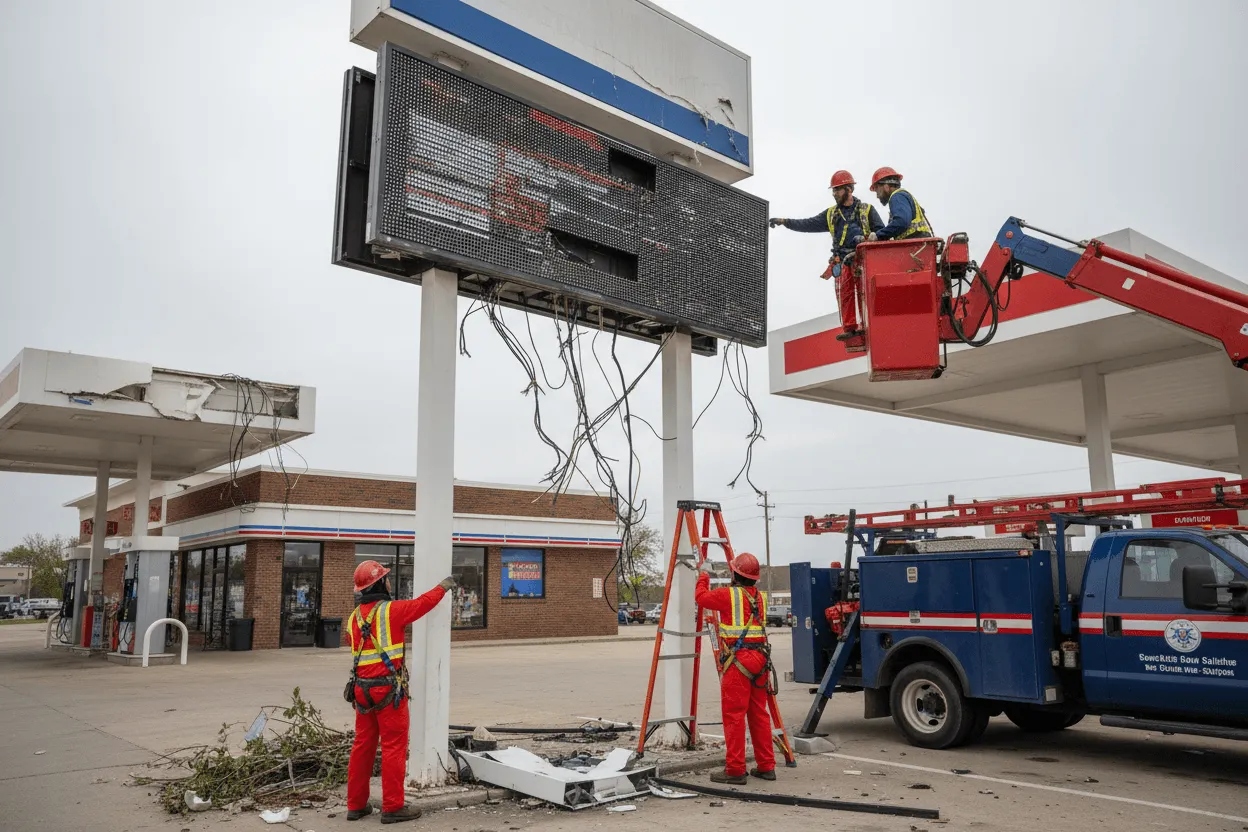
Preventive sign maintenance is scheduled inspection and service that addresses wear items—lamps, power supplies, gaskets, fasteners—before they cause sign failure, typically performed semi-annually or quarterly depending on sign type and exposure. Based on our experience serving national sign companies and facilities management firms across Indiana, scheduled sign maintenance costs 60-70% less than emergency repairs because technicians can order parts in advance, schedule work during optimal weather, and address multiple issues in a single visit.
The math changes everything. A scheduled maintenance visit that replaces ballasts, cleans contacts, and seals weather penetrations might run $450-$650 per sign. That same sign failing after hours during an ice storm? You’re looking at $1,800-$2,400 with rush charges, overnight premiums, and weather delays that require multiple trips.
What Makes Emergency Repairs So Expensive
Emergency sign repair costs spike for reasons procurement managers understand immediately. Rush parts ordering adds 30-40% markup. After-hours service carries time-and-a-half or double-time labor rates. And weather complications common along the I-465 corridor—wind delays, ice accumulation, low visibility—can turn a two-hour repair into a multi-day situation requiring multiple mobilizations.
Hidden Costs of the Reactive Approach
The invoice tells only part of the story. A dark sign means lost brand visibility for your client’s retail tenant. Code violations from non-compliant signage trigger municipal fines. Multiple emergency calls strain your relationship with facility managers who expected reliable performance. Commercial sign service agreements eliminate these cascading issues by keeping signage operational through systematic attention to wear patterns and failure modes.
Need a cost comparison for your sign maintenance program? Contact Midwest Signs to discuss preventive maintenance agreements for your Indianapolis-area portfolio.
Why Do Signs Always Fail at the Worst Possible Time?
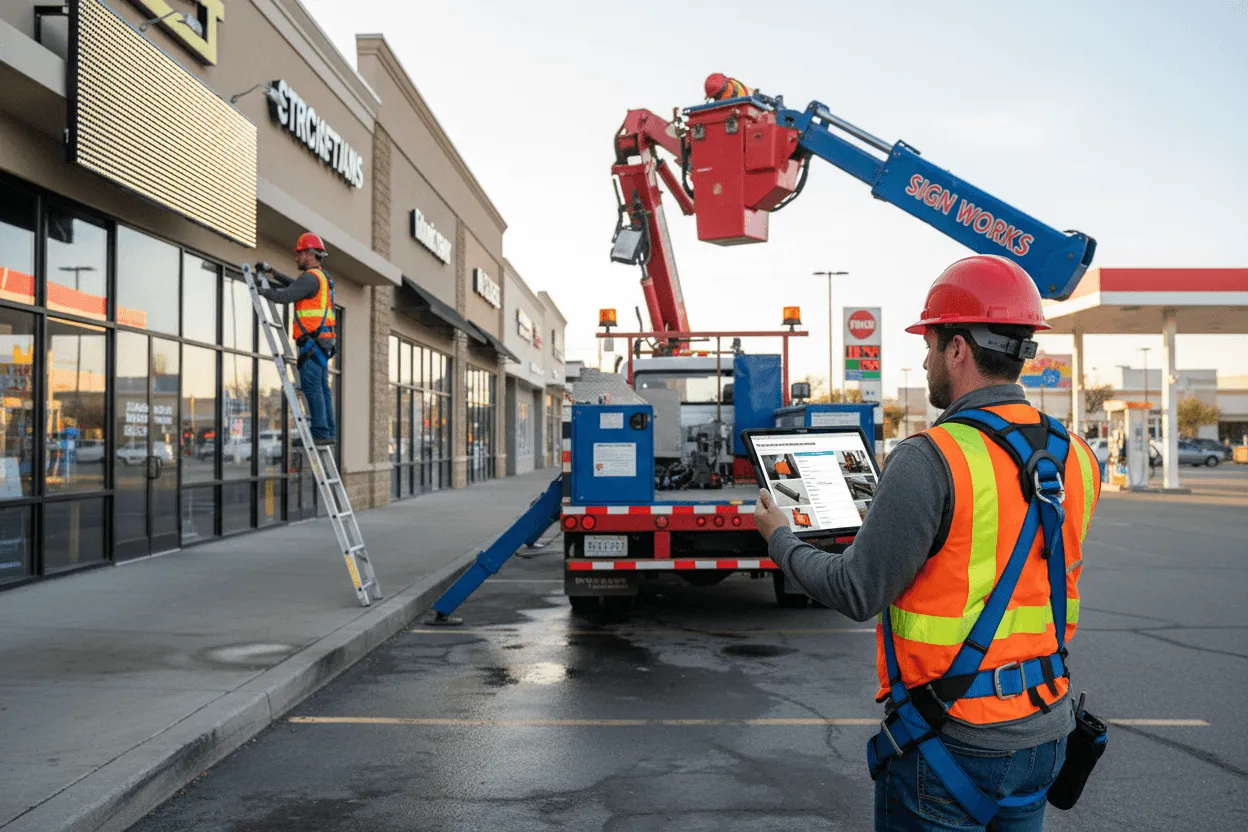
Most sign failures happen during the worst possible times—holiday weekends, severe weather, or overnight—because stress on electrical components and structural fasteners accumulates gradually until a trigger event causes failure. It’s not bad luck. It’s physics.
The Stress-and-Trigger Failure Pattern
Your portfolio’s sign failures follow predictable patterns. Ballasts and transformers run hot for months, degrading insulation slowly. Mounting bolts experience micro-movements with every temperature shift. Then a power surge hits, or temperatures swing 40 degrees overnight, and components that were hanging on finally quit.
Common trigger events include:
- Storm-related power surges that stress already-weakened ballasts
- Freeze-thaw cycles loosening fasteners and cracking weather seals
- High winds exposing structural weaknesses in aging cabinet mounts
- Seasonal temperature swings causing thermal expansion failures
Seasonal Failure Clusters We See Every Year
Indianapolis sign repair crews respond to predictable seasonal waves. Late October through early December brings mounting failures as freeze-thaw cycles hit deteriorated fasteners. Summer storms from June through August cause electrical component failures across multi-location portfolios. And honestly, Black Friday weekend failures happen so consistently that facilities managers should plan seasonal sign maintenance before Thanksgiving, not after.
Understanding failure patterns allows facilities managers to schedule preventive service before predictable high-stress periods rather than reacting after failures occur. Emergency sign repair is reactive service responding to sign failure that has already occurred, typically requiring after-hours or weekend response with associated premium costs and parts procurement delays.
Smart service partners schedule inspections in April and September—before summer storms and winter weather stress your signage when you need visibility most.
What a Professional Sign Maintenance Agreement Should Include
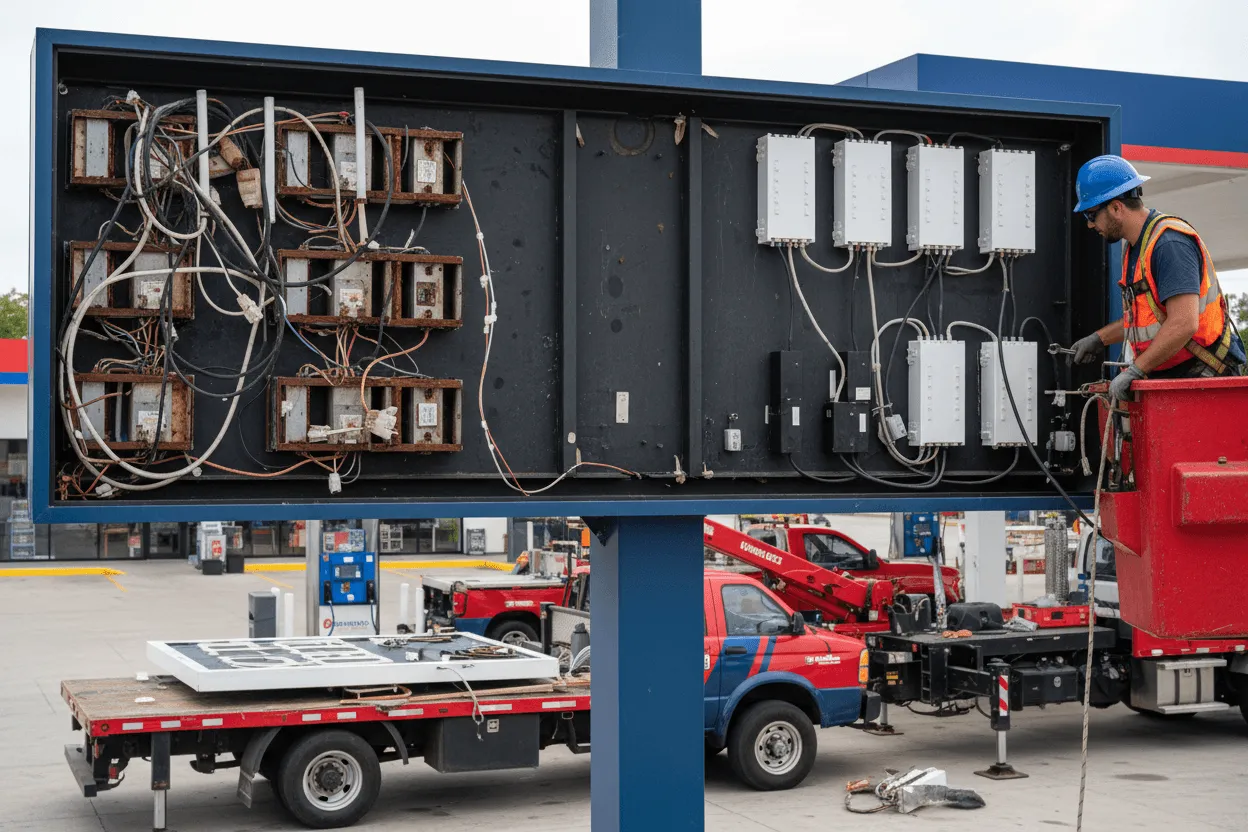
A sign maintenance agreement is a service contract defining inspection intervals, response times, covered services, documentation requirements, and emergency protocols for commercial signage across single or multiple locations. For procurement managers evaluating sign service contracts, the terms separate professional partners from basic service providers.
Core Service Components
The foundation of any maintenance agreement terms should include these essential elements:
- Semi-annual inspections covering structural, electrical, and lighting systems
- Lamp and ballast replacement within 24-48 hours of notification
- Priority emergency response with defined escalation protocols
- Photocell and timer replacement as wear items
- Panel face cleaning and lens maintenance
- Permit coordination for service work requiring local approvals
We structure agreements around scheduled service intervals paired with responsive repair capacity. That balance matters more than just showing up twice a year with a checklist.
Documentation and Reporting Requirements
Your agreement should specify exactly what documentation you receive after each service visit. At Midwest Signs, our paperless system uploads photos, inspection findings, and service reports directly to your project management portal within 24 hours of completing work. That level of transparency helps facilities managers budget for upcoming repairs and maintain compliance documentation.
For multi-location maintenance coordination across Indiana commercial districts, centralized reporting becomes critical. You need visibility into which locations received service, what issues were identified, and what repair quotes are pending.
Emergency Response Protocols
Sign inspection frequency recommendations vary by sign type—monument signs need different attention than pylon signs—but emergency protocols should be consistent. A comprehensive sign maintenance agreement should include semi-annual inspections, lamp replacements within 24-48 hours, emergency response priority, and detailed documentation with photos uploaded to your project management system.
Effective maintenance agreements balance scheduled service with rapid emergency response and provide the documentation facilities managers need for budgeting, compliance, and insurance purposes.
Looking for a service partner who understands Indianapolis commercial sign maintenance coordination? Midwest Signs provides the documentation, response times, and regional coverage national sign companies require.
How LED Retrofits Change Your Maintenance Requirements

LED retrofits reduce maintenance calls by 70-80% compared to fluorescent lamp signs because LED modules last 50,000+ hours versus 18,000 hours for fluorescent tubes and eliminate ballast failures entirely. That’s the data across our national accounts service territory, and it changes how facilities teams budget for ongoing signage costs.
But here’s what matters for project managers coordinating multi-location rollouts: LED conversion should be evaluated as a maintenance reduction strategy that pays for itself through eliminated service calls, not just as an energy efficiency upgrade.
The Maintenance Advantage of LED Technology
Fluorescent signs generate maintenance cycles around predictable failure points. Lamps dim and fail every 18-24 months depending on operating hours. Ballasts fail every 3-5 years. Each failure means a service call, a crew dispatch, and downtime for that location.
LED modules flip that equation. A quality commercial lighting maintenance and LED retrofit eliminates the lamp replacement cycle and removes ballasts from the equation entirely. Gas station canopy conversions in the Hamilton County area run 5+ years between service calls instead of quarterly lamp changes.
What LED Signs Still Need for Service
| Component | Fluorescent Maintenance | LED Maintenance |
|---|---|---|
| Lamp replacement | Every 18-24 months | None—modules last 50,000+ hours |
| Ballast service | Every 3-5 years | Eliminated entirely |
| Power supply service | Minimal | Every 7-10 years typical |
| Module replacement | N/A | 10+ years based on runtime |
LED signs aren’t maintenance-free. Power supplies eventually need service. Individual modules can fail. But the service intervals stretch from months to years, and most maintenance agreements shift from reactive repairs to true preventive inspection schedules.
Documentation and Compliance: Why Maintenance Records Matter in 2026
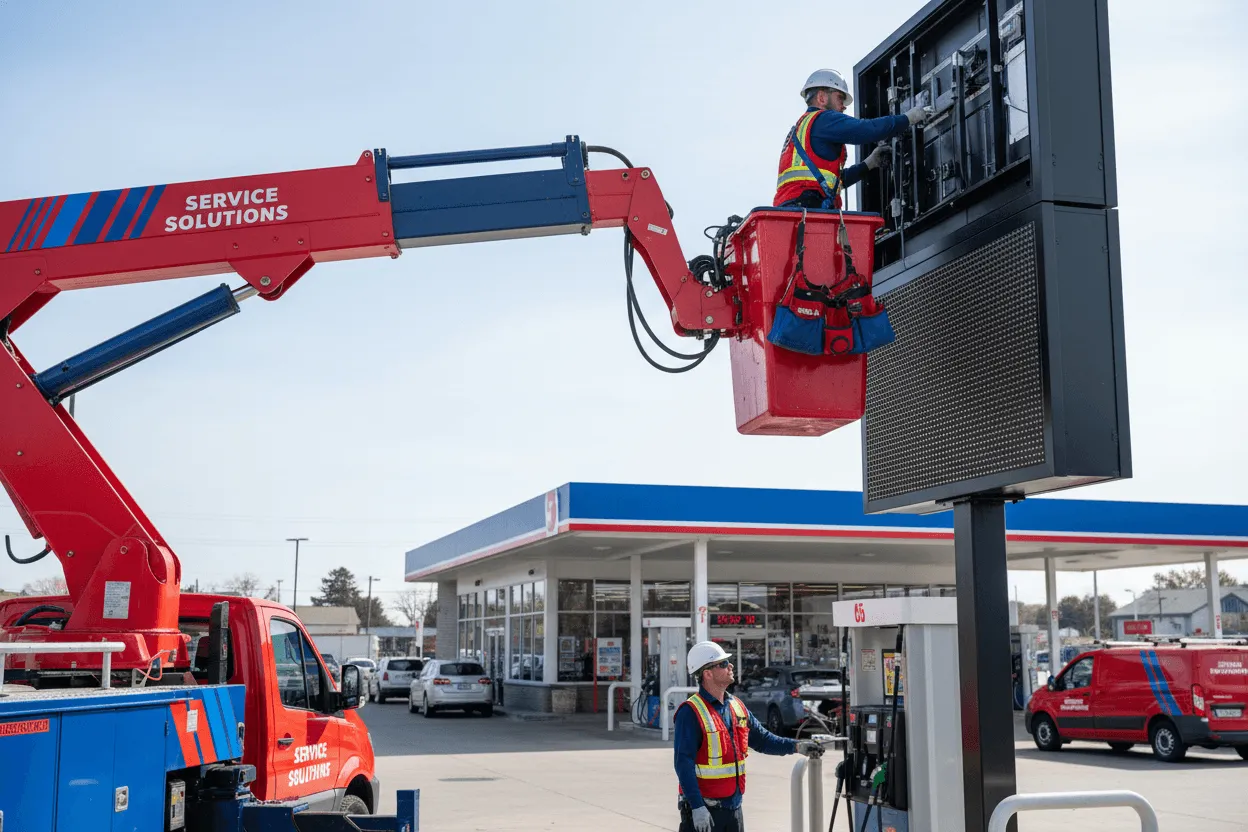
Your insurance carrier won’t take your word anymore when a sign comes down during a storm. In 2026, insurance carriers increasingly require documented maintenance records to approve claims for sign damage, making routine inspection reports a critical risk management tool for property managers. We’ve watched partners scramble to recreate service histories after claims were flagged—not a situation you want to face after wind damage at a retail center.
Here’s what matters: maintenance documentation has evolved from optional record-keeping to essential risk management that protects against insurance disputes and provides the audit trail corporate facilities departments require.
Insurance Requirements for Sign Damage Claims
Commercial property carriers now request sign compliance records dating back 12-24 months before approving structural damage claims. They’re looking for inspection reports showing ballast replacements, structural bolt torque checks, and electrical maintenance that demonstrates reasonable care. Without this paper trail, carriers can deny claims based on “deferred maintenance” arguments.
Our electronic documentation system captures photos, test readings, and parts replaced during every service call. That level of detail becomes crucial when a sign structure fails and you’re filing a $40,000 claim based on our experience serving national accounts across Indianapolis.
Corporate Compliance and Audit Trails
National facilities departments face regular audits requiring proof of code compliance and preventive maintenance adherence. Multi-location partners tracking twenty or more sites need centralized reporting that shows which locations received service, when inspections occurred, and what deficiencies were addressed. Our comprehensive sign assessment and condition reporting ties directly into permit documentation and variance compliance records that auditors demand. Electronic sign maintenance documentation through platforms supporting sign installation Indianapolis operations gives procurement managers the visibility corporate risk departments require in 2026.
═══════════════════════════════════════
CONTENT BEGINS BELOW
═══════════════════════════════════════
Frequently Asked Questions About Sign Maintenance Services in Indianapolis
How much does preventive sign maintenance cost compared to waiting for emergency repairs in Indianapolis?
Preventive sign maintenance typically costs 60-70% less than emergency repairs because service partners can order parts in advance, schedule work during optimal weather, and address multiple issues in a single visit. Emergency repairs often include after-hours premiums, rush part ordering, and weather delays that increase total cost. For multi-location portfolios across Indianapolis and central Indiana, scheduled maintenance agreements provide predictable budgeting and priority response when emergencies do occur.
What should a sign maintenance agreement include for multi-location businesses?
A comprehensive sign maintenance agreement should include semi-annual or quarterly inspections, defined response times for service calls (typically 24-48 hours for partners with agreements), lamp replacement protocols, emergency repair priority, and detailed documentation with photos. For regional portfolios, the agreement should address multi-location coordination, standardized reporting across properties, permit and variance handling, and integration with your existing project management systems. Partners managing a regional sign rollout benefit from consistent service standards across all locations.
How quickly can Midwest Signs respond to sign maintenance issues in Indianapolis?
Midwest Signs provides 24-48 hour response times for service partners with maintenance agreements throughout Indianapolis and all of Indiana. Emergency situations receive priority scheduling, with our fleet of service vehicles positioned to reach commercial corridors including I-465, Castleton, Keystone at the Crossing, and the Airport area efficiently. Response time varies based on parts availability, weather conditions, and whether work requires bucket truck access or specialized equipment.
Do LED signs require less maintenance than traditional fluorescent signs?
LED signs typically require 70-80% fewer maintenance calls than fluorescent signs because LED modules last 50,000+ hours compared to 18,000 hours for fluorescent lamps, and LED systems eliminate ballast failures entirely. LED signs still require periodic inspection of power supplies, connections, and modules, but the reduced service frequency often makes LED retrofit cost-effective purely from maintenance savings, independent of energy cost reductions.
Why does my insurance carrier require documented sign maintenance records?
Insurance carriers increasingly require maintenance documentation to verify that sign damage resulted from covered events rather than neglect or deferred maintenance. Routine inspection reports with photos provide the audit trail needed to approve claims. For commercial properties in Indianapolis, documented maintenance also supports code compliance verification and provides the records corporate facilities departments need for risk management and capital planning purposes.
What areas around Indianapolis does Midwest Signs service for sign maintenance?
Midwest Signs provides sign maintenance services throughout all of Indiana from our Indianapolis facility at 8560 E. 30th St. Our service area includes Marion County, Hamilton County, and commercial corridors throughout central Indiana including Carmel, Fishers, Greenwood, and the I-465 loop. As a service partner to national sign companies, we also coordinate multi-state projects across Indiana, Illinois, Ohio, and Kentucky for regional rollouts and portfolio maintenance programs.